How Accurate Should a Reptile Hygrometer Be
How accurate should a reptile hygrometer be? It's a question that doesn't get asked nearly enough, and the answer has real consequences for your pet's health. A hygrometer that's off by 10% or more can lead to chronic shedding problems, respiratory infections, or dehydration.
The short of it is that most reptiles need a reading within ±3 to 5% of the true humidity.
As of 2026, the consumer hygrometer market offers options ranging from $8 analog dials to $50 digital units with calibration certificates. Our research, drawing on manufacturer specifications and veterinary guidance from the Association of Reptilian and Amphibian Veterinarians, shows that the difference between these tiers isn't just convenience. It's the difference between a safe enclosure and a dangerous one.
Image source: Bing (Web (fair-use with source credit))
Why Accuracy Matters (and Why a Cheap Gauge Can Hurt Your Reptile)
A reptile's health depends on the right humidity level. That's not an exaggeration. It affects everything from shedding to breathing to immune function.
Take a ball python, for example. They need 50 to 60% humidity for normal shedding and respiratory function. Drop below that, and the scales start to stick.
Go above 70% for too long, and you're looking at scale rot or a serious respiratory infection. The Association of Reptilian and Amphibian Veterinarians has documented these links extensively.
The problem is that most cheap hygrometers aren't accurate enough to tell you where you actually are. Aggregate reviews of budget analog dials show errors of 10 to 15% right out of the box. That's not a small margin.
That's the difference between a healthy snake and a vet visit.
And it's not just analog units. Some digital hygrometers drift over time. The sensor ages, the calibration shifts, and suddenly you're trusting a reading that's 5% off.
You wouldn't trust a thermometer that reads 10 degrees low. Your reptile's hygrometer deserves the same scrutiny.
The cost of getting it wrong is steep. Chronic dehydration leads to kidney problems. Stuck shed can constrict toes and tails.
Respiratory infections in reptiles are notoriously hard to treat. They often require multiple vet visits and antibiotics.
So when we ask how accurate a hygrometer needs to be, the answer comes from the animal's needs, not the price tag. A ±5% tolerance is the absolute minimum. For sensitive species, you want ±3% or better.
Every hygrometer should be tested before you trust it. The salt test is the standard method, and we'll walk through it in detail later.
The Short Answer: What's Good Enough and What's Not
For most reptile species, a hygrometer should be accurate to within ±5% relative humidity. For sensitive species like chameleons or tree frogs, aim for ±3% or better. Digital hygrometers are far more reliable than analog dials.
Always test your unit with a salt test before trusting it. Calibrate every three to six months.
Here's what that looks like in practice. A ±5% hygrometer that reads 55% is telling you the true humidity is between 50 and 60%. That's acceptable for most desert and temperate species.
A ±3% unit reading 55% means the real number is between 52 and 58%. That's the margin you need for tropical species.
What's not good enough. Analog dial hygrometers often come with a factory tolerance of ±10% or worse. Some are off by 15 to 20% after a year of use.
That's not a measurement. It's a guess.
The table below shows the accuracy you need for different reptile groups.
| Reptile Group | Target Humidity | Required Accuracy | Recommended Type |
|---|---|---|---|
| Desert species (bearded dragons, leopard geckos) | 30–40% | ±5% | Digital |
| Temperate species (corn snakes, king snakes) | 40–60% | ±5% | Digital |
| Tropical species (crested geckos, ball pythons) | 60–80% | ±3% | Digital with calibration |
| Rainforest species (chameleons, tree frogs) | 70–90% | ±3% | Digital with calibration |
Testing your hygrometer is the only way to know if it's accurate. A unit that costs $15 might be dead on. A unit that costs $50 might be 5% off.
The price tag doesn't guarantee accuracy. The salt test does. We'll show you how to do it in a few minutes.
Core Facts: How Hygrometers Actually Work (and Why They Lie)
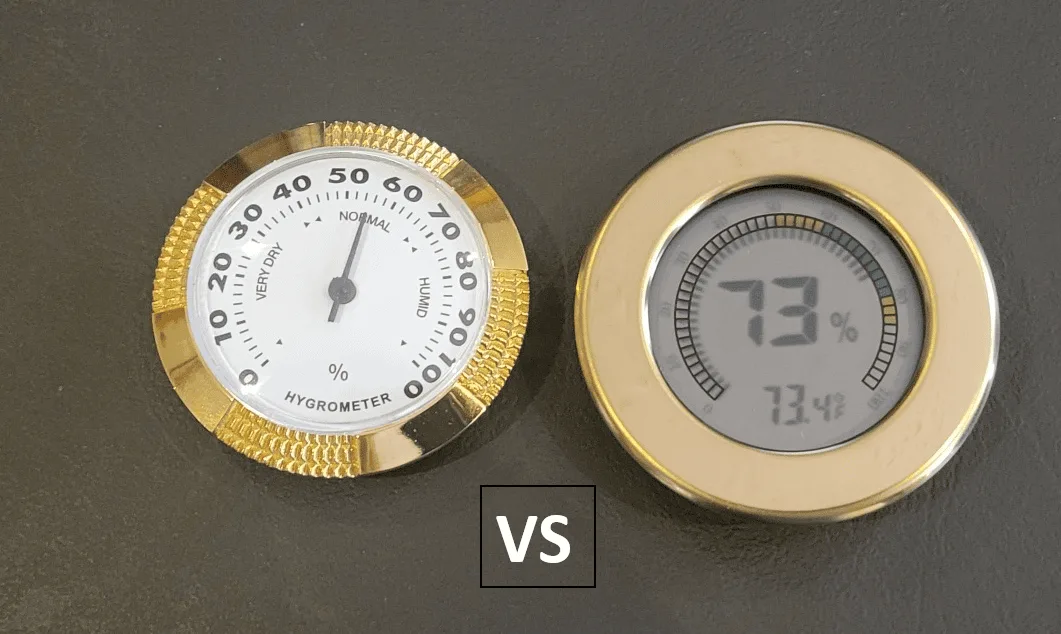
Image source: Bing (Web (fair-use with source credit))
A hygrometer measures relative humidity. That's the amount of water vapor in the air compared to the maximum it can hold at that temperature. But how it measures that varies a lot.
Analog hygrometers use a mechanical sensor. Typically, it's a coil of hair or a synthetic fiber that expands and contracts with moisture. That movement turns a needle on a dial.
The problem is that these materials are slow to respond, they get stuck, and they lose calibration over time. A hair hygrometer can take 30 minutes to register a change. By then, your enclosure's humidity has already shifted.
Digital hygrometers use a capacitive or resistive sensor. A thin layer of material absorbs water, which changes its electrical properties. That change is measured and converted into a humidity reading.
These are faster, more accurate, and more stable. But they're not perfect. The sensor can drift over time, especially if it's exposed to condensation or extreme temperatures.
The biggest reason hygrometers lie is calibration drift. Every sensor ages. The chemical properties of the sensor material change slowly.
A unit that was accurate at the factory might be 5% off after a year. That's why regular testing is critical.
Another reason is placement. Put a hygrometer right above a water dish, and it'll read 10% higher than the rest of the enclosure. Put it under a heat lamp, and the heat will dry out the sensor, giving a falsely low reading.
The sensor needs to be in the middle of the enclosure, away from direct heat and water sources.
Response time is another factor. A good digital hygrometer should respond to a humidity change within 10 to 30 seconds. Analog units can take several minutes.
That delay means you're reacting to what the humidity was, not what it is now.
The Real Risk: What Happens When Your Humidity Reading Is Wrong
When your hygrometer lies, your reptile pays the price. The consequences range from uncomfortable to life-threatening.
Low humidity that goes undetected is the most common problem. If your hygrometer reads 50% but the real humidity is 35%, you won't know your reptile is dehydrating. The first signs are subtle.
The skin looks dull. The eyes seem sunken. The reptile stops eating.
Then the shedding problems start.
Dysecdysis, or stuck shed, is one of the most visible signs of chronic low humidity. Pieces of skin cling to toes, tail tips, and eye caps. If the shed doesn't come off, it can constrict blood flow.
Toes can die. Tail tips can fall off. Eye caps can cause blindness.
High humidity that goes undetected is equally dangerous. If your hygrometer reads 60% but the real humidity is 80%, you're creating a breeding ground for bacteria and fungi. Scale rot starts as small discolored patches.
It spreads quickly. Respiratory infections follow, with wheezing, mucus, and open-mouth breathing.
The National Institute of Standards and Technology provides calibration standards for humidity sensors. Their guidelines emphasize that even a 5% error can lead to significant misinterpretation of environmental conditions. For a reptile, that 5% error is the difference between health and illness.
The cost of treating these problems is high. A vet visit for a respiratory infection can run $100 to $300. Antibiotics cost more.
Some reptiles don't survive the treatment. All of this is preventable with a hygrometer that you know is accurate.
Some species are more sensitive than others. Chameleons are extremely sensitive to humidity changes. They can develop respiratory infections from a week of incorrect humidity.
Ball pythons are prone to scale rot if humidity stays too high. Crested geckos need consistent humidity for proper shedding. The risk is real, and it's completely avoidable.
How to Check and Fix Your Hygrometer's Accuracy (Step-by-Step)
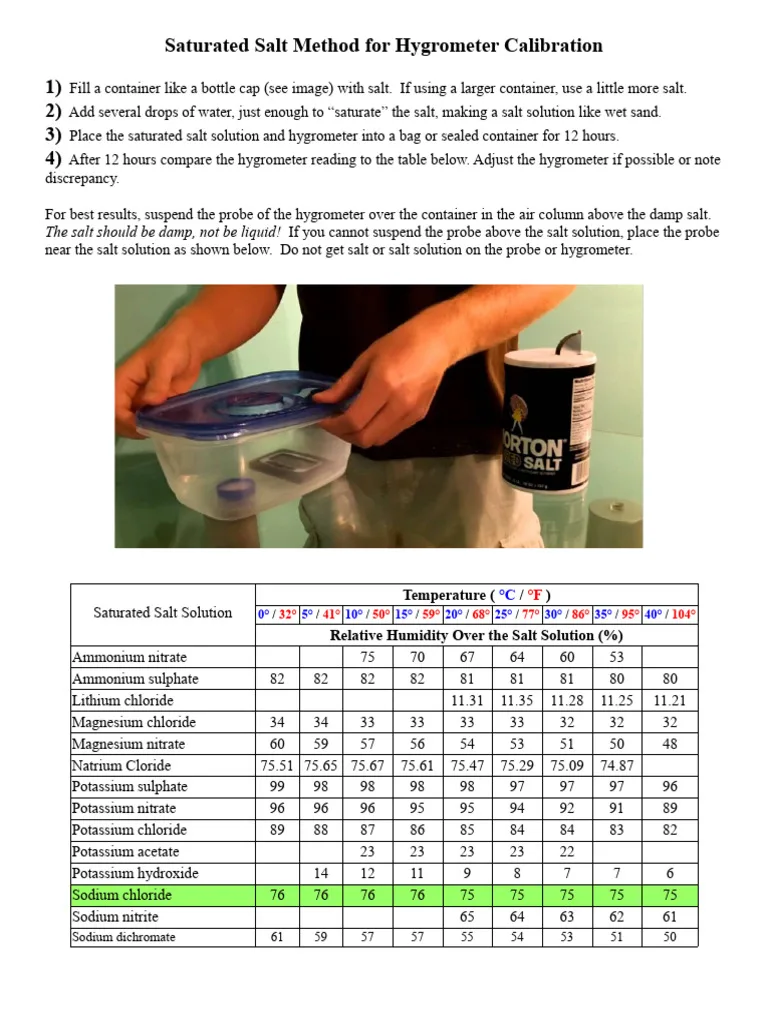
Image source: Bing (Web (fair-use with source credit))
The salt test is the standard way to check your hygrometer's accuracy. It's cheap, simple, and reliable. Here's how to do it.
Step 1: Gather your materials. You need table salt, a small bottle cap or container, a sealable plastic bag or jar, and your hygrometer.
Step 2: Moisten the salt. Put a tablespoon of salt in the cap. Add enough water to make it damp, but not dissolved. The salt should be wet, not swimming.
Step 3: Place the salt and hygrometer in the bag. Put the cap of damp salt and your hygrometer inside the bag. Seal it tight. Make sure the hygrometer sensor is not touching the salt directly.
Step 4: Wait 8 to 12 hours. The salt creates a stable humidity of exactly 75% inside the sealed container. This is a known scientific fact. Salt water at saturation has a fixed relative humidity of 75.1% at 68°F.
Step 5: Check the reading. After 8 to 12 hours, read the hygrometer without opening the bag. It should read 75%. If it reads 70%, it's off by 5%.
If it reads 80%, it's off by 5%.
Step 6: Adjust or replace. Some digital hygrometers have a calibration adjustment. If yours does, adjust it to read 75%. If it doesn't, note the error and add or subtract it from all future readings.
If the error is more than 5%, replace the unit.
Test every hygrometer when you first buy it. Then test again every three to six months. Mark the date on the battery compartment so you don't forget.
If you notice sudden changes in your reptile's behavior or shedding, test immediately. The salt test takes 12 hours, but it's the only way to be sure.
If your hygrometer doesn't have a calibration adjustment, don't throw it away. Just note the offset. If it reads 70% when it should be 75%, subtract 5% from all readings.
If it reads 80%, add 5%. This isn't ideal, but it works until you can replace the unit.
Frequently Asked Questions About Hygrometer Accuracy
How often should I calibrate my reptile hygrometer?
Calibrate a new hygrometer immediately before first use. Then test it every three to six months. Mark the date on the unit with a permanent marker.
If you notice sudden shedding problems or behavior changes, test right away. Drift happens slowly, so regular checks catch it before problems start.
What is the salt test and how does it work?
The salt test checks your hygrometer against a known standard. Wet salt creates a stable 75% relative humidity inside a sealed container. Place your hygrometer and damp salt in a bag for 8 to 12 hours.
Read the value. It should show 75%. Any difference is your error margin.
Can I trust an analog hygrometer for my reptile enclosure?
Analog dial hygrometers are not reliable enough for reptile care. They typically have a factory tolerance of ±10% or worse. They drift faster than digital units and respond slowly to humidity changes.
Our research indicates they are best avoided entirely. A basic digital hygrometer is much safer.
Where should I place the hygrometer in the enclosure?
Place the sensor in the middle of the enclosure, away from heat lamps and water dishes. The basking spot and the cool end have different humidity levels. Measure the ambient air in the central zone.
For larger enclosures, use two sensors to monitor both ends of the gradient.
What accuracy do I need for a ball python versus a chameleon?
A ball python needs a hygrometer accurate to within ±5% because their target range is 50 to 60%. A chameleon needs ±3% or better because they require 70 to 90% humidity. The tighter the target range, the more precision you need.
A ±3% unit covers both species safely.
How do I know if my hygrometer has calibration drift?
The most common sign is a sudden change in your reptile's shedding quality or behavior. Stuck shed, dull skin, or lethargy can indicate incorrect humidity. Run a salt test to confirm.
If the error is more than 5%, replace the unit. Consistent calibration is the only way to be sure.