Can You Use a Dehumidifier in a Living Room
There's nothing quite like walking into your living room and feeling that sticky, heavy air. Or maybe it's the musty smell that hits you first. If you're wondering, "can you use a dehumidifier in a living room?" the short answer is yes, absolutely.
Per ASHRAE standards, the ideal indoor relative humidity sits between 30 and 50 percent. If your living room consistently measures above that range, a dehumidifier can help. But the real question isn't just whether you can use one.
It's whether you should, and how to do it right for your specific situation.

Image source: Web (Bing) / evolvedigitas.blogspot.com (Web image (fair-use with source credit))
The Problem: Humidity in Your Living Room
High humidity in a living room isn't just uncomfortable. It's actively damaging your space and your health.
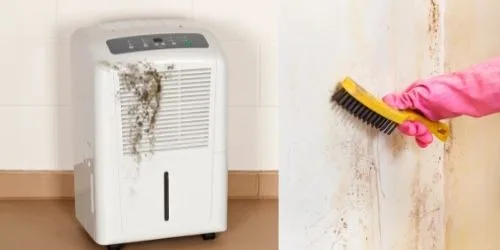
When indoor humidity climbs above 60 percent, you're inviting mold and mildew to set up shop. Dust mites thrive in that environment too. Your wooden furniture can warp.
Electronics can corrode. And that sticky feeling on your skin? That's your body struggling to cool itself because the air is too saturated for sweat to evaporate.
The signs are usually pretty obvious. You might see condensation on your windows in the morning. Maybe there's a musty smell that doesn't go away.
Or you notice that the air feels damp even when the AC is running. According to the EPA, indoor humidity levels above 60 percent can also trigger respiratory issues and allergy flare-ups.
If you're dealing with any of these symptoms, you've got a humidity problem worth solving. A dehumidifier is one of the most effective tools for the job. But it's not a one-size-fits-all solution.
Your living room's size, layout, climate, and existing HVAC setup all matter.
Quick Answer
Yes, you can use a dehumidifier in a living room. It's a common and effective fix for indoor humidity problems. The right choice depends on your room's size and your specific situation.
Start by measuring your current humidity level with a hygrometer.
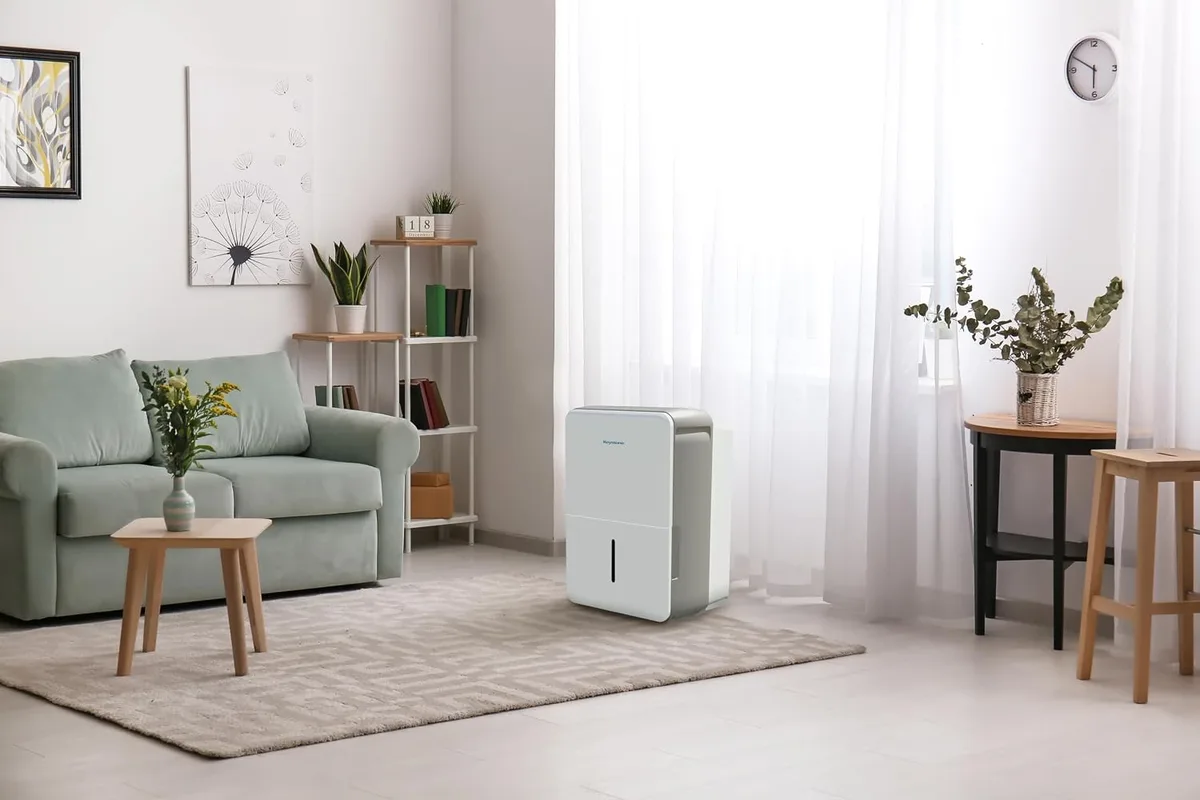
Image source: Bing (Web (fair-use with source credit))
The 5 Key Factors That Decide If You Should Use a Dehumidifier in Your Living Room
Not every living room needs a dehumidifier. Here are the five factors that determine whether one makes sense for you.
1. What's your current humidity level?
This is the most important question. You need a hygrometer. They cost about $10 to $15 and give you an instant reading.
If your living room consistently sits above 50 percent relative humidity, a dehumidifier will help. Below 30 percent, you actually need a humidifier (dry air causes cracked wood and respiratory irritation). The sweet spot is 40 to 50 percent.
2. Is your living room damp or experiencing visible condensation?
Check your windows in the morning. If you see water droplets collecting on the glass, that's a clear sign of excess moisture. The same goes for damp spots on walls or a musty smell that lingers after cleaning.
These are all indicators that the air is holding more water than it should.
3. What's the room size?
A 30-pint dehumidifier might be perfect for a 500-square-foot living room. But if your space is open-plan and runs 1,000 square feet or more, you'll need a 50-pint or 70-pint unit. Undersizing means the machine runs constantly without ever catching up.
Oversizing wastes energy and can make the room feel too dry. Manufacturer specifications usually list the coverage area in square feet for each capacity.
4. What's your climate and season?
If you live in a humid coastal region like the Gulf Coast or Southeast Asia, you probably need a dehumidifier year-round. In northern climates, humidity is often a seasonal problem that peaks in summer and disappears in winter. For cold-weather use, a desiccant dehumidifier works better than a compressor unit because compressor models struggle below 60°F.
5. Do you have health concerns or sensitive items?
People with asthma or allergies often benefit from lower humidity because dust mites and mold spores can't thrive below 50 percent. Similarly, if your living room houses expensive electronics, musical instruments, or wooden furniture, keeping humidity in check protects those investments. The EPA recommends maintaining indoor humidity below 60 percent for respiratory health and below 50 percent for dust mite control.
Here's a quick reference table to help you decide:
| Factor | If Yes | If No |
|---|---|---|
| Humidity above 50% | Dehumidifier helps | Skip it |
| Visible condensation | Dehumidifier helps | Not needed |
| Room > 500 sq ft | Choose 50+ pint capacity | Choose 30-pint or less |
| Humid climate year-round | Use compressor unit | Use desiccant for cold |
| Health concerns or valuables | Dehumidifier worthwhile | Lower priority |
How to Choose the Right Dehumidifier for Your Living Room (Step-by-Step)
Once you've decided a dehumidifier makes sense, here's the process to pick the right one.
Step 1: Measure your room size
Grab a tape measure or use a laser distance tool. Multiply length by width to get square footage. Don't forget to include connected hallways or open-plan areas if there's no door separating them.
The dehumidifier treats the air in the whole open space, not just the room it sits in.
Step 2: Gauge your dampness level
The AHAM (Association of Home Appliance Manufacturers) uses three categories: moderately damp (musty smell, no visible moisture), very damp (wet spots, some mold), and wet (standing water, flooding). For a living room, you're probably in the moderately damp or very damp category. That matters because it affects how much capacity you need.
Step 3: Match capacity to the situation
For a moderately damp 500-square-foot living room, a 30-pint unit works fine. For very damp spaces of the same size, step up to a 40-pint unit. If your living room is 1,000 square feet, you'll want a 50-pint model for moderate dampness and a 70-pint model for heavy dampness.
If you're looking for a model that handles varied conditions well, check out the best options for year-round use.
Step 4: Think about noise
Living rooms are where you relax, watch TV, and talk. A noisy dehumidifier is a dealbreaker. Most portable units run at 40 to 55 decibels.
That's about the same as a quiet conversation or a refrigerator hum. If noise is a concern, look for models with a "sleep mode" or "low fan" setting. Desiccant units tend to be quieter than compressor units, but they're less efficient in warm weather.
Step 5: Decide on drainage
You have two options. The first is the built-in water tank, which you empty manually. The second is continuous drainage via a hose connected to a floor drain or a sink.
For a living room, continuous drainage is ideal if you're on the ground floor and have a drain nearby. But if you're on a higher floor, a large tank (at least 10 liters) is your best bet. Just remember to empty it regularly.
5 Common Mistakes People Make With a Living Room Dehumidifier
Even a good dehumidifier can fail if you set it up wrong. Here are the mistakes to avoid.
1. Putting it in a corner
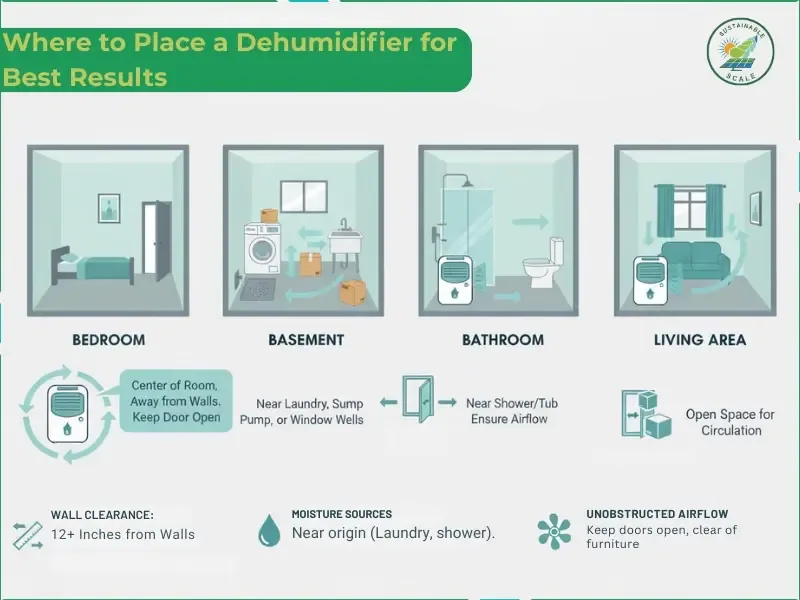
Image source: Bing (Web (fair-use with source credit))
Dehumidifiers need airflow. They pull air in from the sides or front and exhaust it out the top or back. If you shove the unit into a corner or against a wall, it can't circulate properly.
Keep it at least 6 to 12 inches from any wall or furniture. The ideal spot is in the center of the room, near the main source of moisture (like a bathroom door or kitchen opening).
2. Setting the humidity too low
It's tempting to set the humidistat to 30 percent and walk away. Don't do that. The air gets uncomfortably dry.
Your skin cracks. Wood furniture shrinks and splits. And your sinuses will feel raw.
The sweet spot is 40 to 50 percent. That's dry enough to stop mold and dust mites but not so dry that it causes problems.
3. Ignoring the filter
The filter catches dust, pet hair, and other particles. When it clogs, airflow drops and the unit works harder. Clean it every two to four weeks with a vacuum or a rinse under the tap.
Replace it every three to six months depending on the manufacturer's recommendation. A dirty filter can cut efficiency by 30 percent or more.
4. Buying the wrong size
We touched on this earlier, but it's worth repeating. A 20-pint unit in a large living room runs all day without ever catching up. A 70-pint unit in a small room makes the space feel like a desert.
If you're unsure about sizing, a 50-pint unit is a solid middle ground for most living rooms. The best 50-pint dehumidifiers for large rooms often include features like continuous drainage and washable filters that make maintenance easier.
5. Running it when the AC is already working
Air conditioners also remove humidity as a byproduct of cooling. If your AC is already running and keeping humidity below 55 percent, adding a dehumidifier might be redundant. You'll just waste electricity and dry out the air.
The exception is if your AC struggles to keep up with humidity because it's oversized or poorly maintained. In that case, a standalone dehumidifier can help pick up the slack.
Real Scenarios: When a Dehumidifier Makes Sense – and When It Doesn't
Let's look at a few common situations. This will help you place your own living room in the right category.
Scenario A: The coastal living room. You live in Florida or the Gulf Coast. Your living room windows sweat in the morning. The AC runs constantly but the air still feels damp.
A 50-pint or 70-pint compressor dehumidifier is almost mandatory here. Run it in the living room during the day and let the continuous drainage hose feed into a nearby floor drain. This is a textbook case where a dehumidifier pays for itself in comfort and furniture protection.
Scenario B: The northern seasonal damp. You live in the Midwest. The living room is fine in winter but gets sticky in July and August. A smaller 30-pint unit works well.
You can store it in the closet for the other nine months. If your living room is on the cooler side, consider a desiccant model that handles lower temperatures better.
Scenario C: The open-plan apartment. Your living room merges with the kitchen. Cooking steam adds moisture to the whole space. A 40-pint unit placed near the kitchen opening catches the humidity before it spreads.
Just make sure the unit isn't blocked by furniture or counters.
When it does not make sense. If your living room humidity stays below 50 percent naturally, skip the dehumidifier. If your central AC handles humidity well (check with a hygrometer), you do not need one. And if the room is under 200 square feet, a small 20-pint unit might be overkill.
A budget-friendly option exists for smaller spaces, but for most living rooms, the 30-pint size is the practical minimum.
Frequently Asked Questions
How long does it take for a dehumidifier to lower humidity in a living room?
Most portable units drop humidity by 10 to 15 percentage points in the first 24 hours. The exact time depends on the starting humidity, room size, and unit capacity. A 50-pint unit in a moderately damp 800-square-foot living room usually reaches your target within 12 to 18 hours.
Can I run a dehumidifier and an air conditioner at the same time?
Yes, but it is often redundant. Air conditioners remove humidity as they cool. If your AC keeps humidity below 55 percent, the dehumidifier adds little value.
However, if your AC is oversized or poorly maintained, a dehumidifier can help. Running both will increase your electricity bill.
Where should I place a dehumidifier in my living room?
Place it in the center of the room or near the main moisture source. Keep it at least 6 to 12 inches from walls and furniture. Avoid corners and areas behind curtains.
The unit needs unobstructed airflow on all sides to work efficiently.
Will a dehumidifier make my living room too dry?
Only if you set the humidity too low. Keep the target between 40 and 50 percent. Below 30 percent, you risk dry skin, static electricity, and cracked wood furniture.
Most modern units have a built-in humidistat that shuts off automatically when the target is reached.
How much electricity does a dehumidifier use in a living room?
A typical 50-pint unit draws about 500 to 700 watts. At the average US electricity rate of $0.12 per kWh, running it 12 hours a day costs about $0.70 to $1.00 per day. That adds up to roughly $20 to $30 per month.
Energy Star certified models are about 15 percent more efficient.
Can I use a dehumidifier in a living room with plants?
Yes, but be careful. Most houseplants prefer humidity between 50 and 60 percent. If you set your dehumidifier to 40 percent, some plants may struggle.
Group moisture-loving plants together and place them away from the dehumidifier. You can also run the unit only during certain hours to balance plant needs with comfort.
The Final Decision Guide: Should You Get a Dehumidifier for Your Living Room?
Here is a simple checklist to make your final call.
| Condition | Action |
|---|---|
| Humidity consistently above 50% | Get a dehumidifier |
| Visible condensation on windows | Get a dehumidifier |
| Musty smell or minor mold spots | Get a dehumidifier |
| Room size 500 sq ft or less | Choose 30-pint or 40-pint |
| Room size 500 to 1,000 sq ft | Choose 50-pint |
| Room size over 1,000 sq ft | Choose 70-pint or whole-house |
| Humid climate year-round | Compressor unit with continuous drain |
| Cold climate or seasonal use | Desiccant unit or smaller compressor |
| Allergy or asthma concerns | Pair with a clean filter, set to 40-50% |
| Budget conscious | Look for Energy Star rated models |
If you checked any of the top three conditions, a dehumidifier is a worthwhile investment for your living room. Start with a hygrometer to confirm your baseline. Then match the capacity to your room size and dampness level.
Set the target to 45 percent and let the unit do the rest.
The EPA recommends keeping indoor humidity between 30 and 50 percent for health and comfort. A dehumidifier is one of the most effective tools to get you there. Just avoid the common mistakes we covered, and you will enjoy a fresher, more comfortable living space all year round.