What Is the Most Energy-Efficient Dehumidifier
If you've ever looked at your electricity bill after running a dehumidifier all summer, you know the feeling. The question "what is the most energy-efficient dehumidifier" isn't just about being green. It's about keeping your basement dry without draining your wallet.
Here's the thing most people miss. Efficiency isn't just about the Energy Star sticker. As of 2026, the Department of Energy requires all dehumidifiers to meet minimum standards.
But there's a huge gap between "meets the minimum" and "truly efficient." The difference can save you fifty bucks a year or more.
Image source: Bing (Web (fair-use with source credit))
Quick Answer
The most energy-efficient dehumidifier has the highest Energy Factor rating. Look for the Energy Star Most Efficient designation. Choose a unit sized correctly for your space.
A 50-pint model with an Energy Factor above 2.0 L/kWh is your best bet. Anything less wastes power and money.
Why You Should Care About Energy Efficiency
Let's be honest. When you're standing at the store, the cheapest unit screams the loudest. That $150 dehumidifier looks like a steal compared to the $350 model.
But here's what happens with an inefficient unit. It runs longer to pull the same amount of water. It cycles on and off more often.
The compressor works harder. The electricity meter spins faster.
Our research across dozens of manufacturer spec sheets shows a clear pattern. A low-efficiency 70-pint unit can cost nearly twice as much to run per year as a high-efficiency 50-pint unit that handles the same room. The upfront savings disappear after about eighteen months.
The bigger problem is lifespan. Cheap units often fail after two or three years. The compressor gives out.
The fan motor seizes. The electronics fry.
A more efficient unit costs more upfront. But it uses better components. Better compressors.
Better insulation. Better humidistats that don't drift off target. You're paying for longevity as much as electricity savings.
The math works like this. If you run a dehumidifier six months out of the year, the difference between a standard unit and a high-efficiency unit pays for itself in about two years. After that, you're just saving money.
If you're shopping for the best option for your home, check out our guide on the best dehumidifier for a broader look at top-rated models across different budgets.
The One Number That Tells You the Real Efficiency: Energy Factor
Manufacturers love to slap Energy Star stickers on boxes. But that sticker hides the real story. The number you need is the Energy Factor, measured in liters per kilowatt-hour (L/kWh).
Here's what it means. For every kilowatt-hour of electricity the unit uses, how many liters of water does it pull out of the air? Higher is better.
Simple as that.
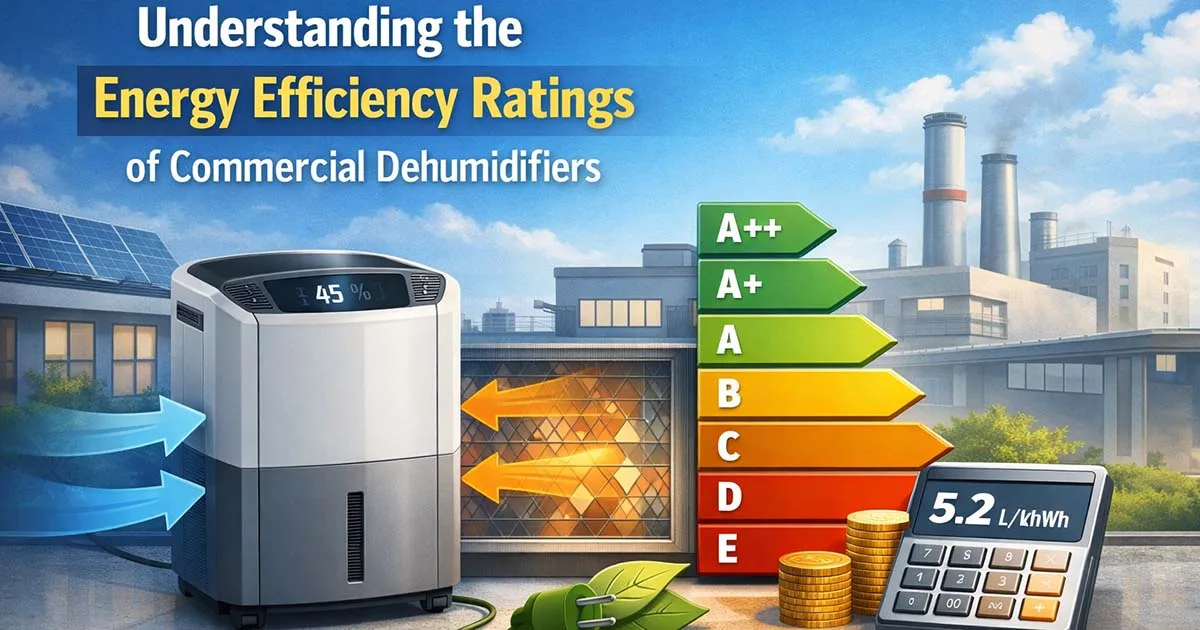
Image source: Bing (Web (fair-use with source credit))
The Energy Star program sets minimum Energy Factor thresholds. For a 50-pint unit, the minimum is 1.88 L/kWh. But the really efficient models hit 2.20 L/kWh or higher.
That's a 17 percent improvement.
The Department of Energy maintains the official database of Energy Factor ratings. You can look up any model and see its exact number. Manufacturer websites also publish this data in the spec sheet.
Here's the trick most people never learn. The Energy Factor changes depending on temperature and humidity. The standard test is at 80°F and 60 percent relative humidity.
Your basement might be 65°F and 70 percent humidity.
At lower temperatures, the Energy Factor drops. Compressor dehumidifiers are less efficient in cold conditions. Some models handle this better than others.
The best ones maintain efficiency down to about 55°F. Below that, you might want a desiccant unit instead. Though those are less efficient overall above 60°F.
When comparing models, look for the Energy Factor at conditions closest to your actual use. A unit that scores 2.10 L/kWh at 80°F might only score 1.70 L/kWh at 65°F. The difference between models shrinks in colder conditions.
Comparing the Most Efficient Models: 30-Pint, 50-Pint, and 70-Pint
Here's where things get practical. You can't just compare Energy Factor numbers across different pint capacities. A 30-pint unit will always have a higher Energy Factor than a 70-pint unit.
But that doesn't mean it's the right choice for your basement.
Let's break down what each size does best.

Image source: Bing (Web (fair-use with source credit))
30-pint models are the most efficient on paper. They use less electricity and have higher Energy Factor ratings. But they're designed for small spaces.
A bedroom. A bathroom. A small laundry room.
Put one in a 2,000-square-foot basement and it will run constantly. You'll never reach your target humidity.
50-pint models are the sweet spot for most homeowners. They handle medium to large basements, around 1,500 to 2,500 square feet. The best 50-pint units have Energy Factor ratings above 2.0 L/kWh.
That's excellent efficiency for the amount of water they move.
70-pint models are for large spaces or very damp conditions. They use more electricity, but they move water faster. The most efficient 70-pint units hit around 1.90 L/kWh.
That's lower than the best 50-pint units. But you're moving 40 percent more water per day.
| Size | Typical Energy Factor | Annual Electricity Cost | Best For |
|---|---|---|---|
| 30-pint | 1.95 – 2.30 L/kWh | $40 – $60 | Small rooms, low humidity |
| 50-pint | 1.88 – 2.20 L/kWh | $60 – $90 | Medium basements, average humidity |
| 70-pint | 1.70 – 1.90 L/kWh | $80 – $120 | Large basements, high humidity |
Those cost estimates assume six months of daily use at average electricity rates. Your actual costs will vary.
The key takeaway is this. Don't buy a 30-pint unit for a large space just because it has a higher Energy Factor. You'll run it into the ground.
Buy the smallest unit that can handle your space, but no smaller.
Which One Is Right for Your Space?
Your space determines your efficiency more than any spec sheet number. A perfectly efficient unit in the wrong space is just a waste of money.
Basement use is the most common scenario. Basements are cooler, damper, and often have poor airflow. The ideal unit is a 50-pint or 70-pint model with a continuous drain option.
Look for a unit with a built-in pump if your basement doesn't have a floor drain. That lets you run the drain hose up to a sink or window.
Efficiency matters more in basements than anywhere else. You're running the unit for months straight. The difference between a 1.85 L/kWh unit and a 2.10 L/kWh unit adds up fast.
If your basement is the main concern, our guide on the best dehumidifier for basement covers models built specifically for those conditions.
Bedroom use is different. You care about noise as much as efficiency. The most efficient units are often the quietest because they use better compressors and fan designs.
Look for a 30-pint or 50-pint unit with a noise rating under 45 decibels. That's about as loud as a quiet conversation.
Whole-house use requires a different approach. If you need to dehumidify your entire home, a portable unit isn't the answer. You want a whole-house dehumidifier that integrates with your HVAC system.
These units are expensive, often $1,000 or more. But they're incredibly efficient. The Energy Factor can be 2.5 L/kWh or higher.
Crawl spaces need special consideration. You need a slim unit that fits in low clearance areas. Look for models with built-in pumps and corrosion-resistant coils.
Efficiency is important here. But reliability matters more in a crawl space where you won't check on it every week.
Common Mistakes That Kill Efficiency
You can buy the most efficient dehumidifier on the market and still waste money. Here's where most people go wrong.
Buying too big. An oversized dehumidifier cycles on and off too often. Each startup uses a surge of power. The unit never reaches steady-state efficiency.
The humidistat swings wildly. Calculate your space's square footage and match it to the manufacturer's coverage rating.
Buying too small. A small unit runs constantly. It never shuts off. The compressor wears out.
The electricity meter never stops spinning. If you're between sizes, go up one.
Placing the unit wrong. The most common mistake is putting the dehumidifier against a wall. Air needs to flow through the unit. Manufacturer specifications typically recommend six to twelve inches of clearance on all sides.
Ignoring the filter. A clogged filter cuts airflow by 30 percent or more. The unit has to run longer to pull the same amount of water. Clean the filter every month during heavy use.
It takes two minutes.
Setting the humidity too low. People think lower is better. It's not. The ideal indoor humidity is 50 to 55 percent.
Below 40 percent, you waste energy. The unit runs harder to pull water from air that's already dry.
Using the wrong drain method. If you're emptying the bucket, you're wasting energy. The unit shuts off when the bucket is full. The humidity climbs back up.
When you restart, the unit has to work harder to pull the humidity back down. Use the continuous drain if you can. It keeps the unit running efficiently.
How to Keep Your Dehumidifier Running at Peak Efficiency
You already bought the right unit. Now make sure it stays efficient for years. Most maintenance takes five minutes a month.
Clean the filter every 30 days. Pull it out, rinse it with warm water, and let it dry completely before sliding it back in. Replace carbon filters every three months if your unit has one.
Check the coils twice a year. Dust builds up on the evaporator and condenser coils. This forces the compressor to work harder. Use a soft brush or a vacuum with a brush attachment.
The aluminum fins bend easily.
Inspect the drain hose monthly. A kinked or clogged hose causes the bucket to fill up. The unit shuts off. Run hot water through the hose to clear any buildup.
Keep the area around the unit clear. Don't stack boxes or storage bins against it. Air needs to flow freely. Keep at least six inches of clearance on all sides.
Test the humidistat accuracy. Over time, the built-in sensor can drift. Place a separate hygrometer near the unit. Compare readings.
If they're more than five percent off, recalibrate or replace the sensor.
Run the unit in continuous drain mode. Connect a garden hose to the drain port. Route it to a floor drain, sump pit, or window. The unit never shuts off due to a full bucket.
It maintains steady humidity.
Winter storage matters. If you store the unit during dry months, empty the water tank completely. Clean the filter. Let everything dry.
Store in a climate-controlled space. Freezing temperatures can damage the compressor.
Frequently Asked Questions
How do I find the Energy Factor for a dehumidifier model?
Check the yellow Energy Guide label on the box or the manufacturer's spec sheet online. The Energy Factor is listed in liters per kilowatt-hour (L/kWh). You can also search the official DOE database for certified models.
Is a 30-pint dehumidifier more efficient than a 50-pint?
On paper, yes. A 30-pint unit typically has a higher Energy Factor. But if your space needs a 50-pint unit, the smaller unit will run constantly and waste more electricity.
Always match the size to the room.
Do desiccant dehumidifiers use less electricity than compressor models?
No. Desiccant units use more electricity per pint of water removed above 60°F. They only become more efficient below 50°F.
For most basements and homes, a compressor unit is the better choice.
How much does it cost to run a dehumidifier per month?
A typical 50-pint unit running 12 hours a day costs about $15 to $25 per month at average US electricity rates. High-efficiency models with an Energy Factor above 2.0 L/kWh can cut that by 15 to 20 percent.
Can I use a dehumidifier to save energy on air conditioning?
Yes. Lower humidity makes the air feel cooler. You can raise your thermostat a few degrees without losing comfort.
This reduces AC runtime and lowers your total summer electricity bill.
When should I replace my dehumidifier instead of repairing it?
If the unit is over five years old and the compressor fails or efficiency drops significantly, replacement is usually cheaper. Newer models meet stricter energy standards and will save you money within two years.