Can a Dehumidifier Be Too Small for a Room
You bought a dehumidifier hoping it would finally knock out that damp basement air. Instead it runs all day, the bucket fills twice, and the room still feels clammy. The honest question is: can a dehumidifier be too small for a room?
Yes, absolutely, and it's one of the most common mistakes people make.
Manufacturer specifications typically list a maximum square footage, but those numbers assume ideal conditions like 70°F and moderate humidity. Real basements and humid climates can require 30 to 50 percent more capacity. That gap between what the box says and what your room needs is where undersizing happens.
Quick Answer
Yes, a dehumidifier can be too small for a room. An undersized unit runs constantly but never reaches the target humidity. It wastes electricity, wears out faster, and fails to prevent mold or musty odors.
Match pint capacity to actual room conditions, not just square footage.
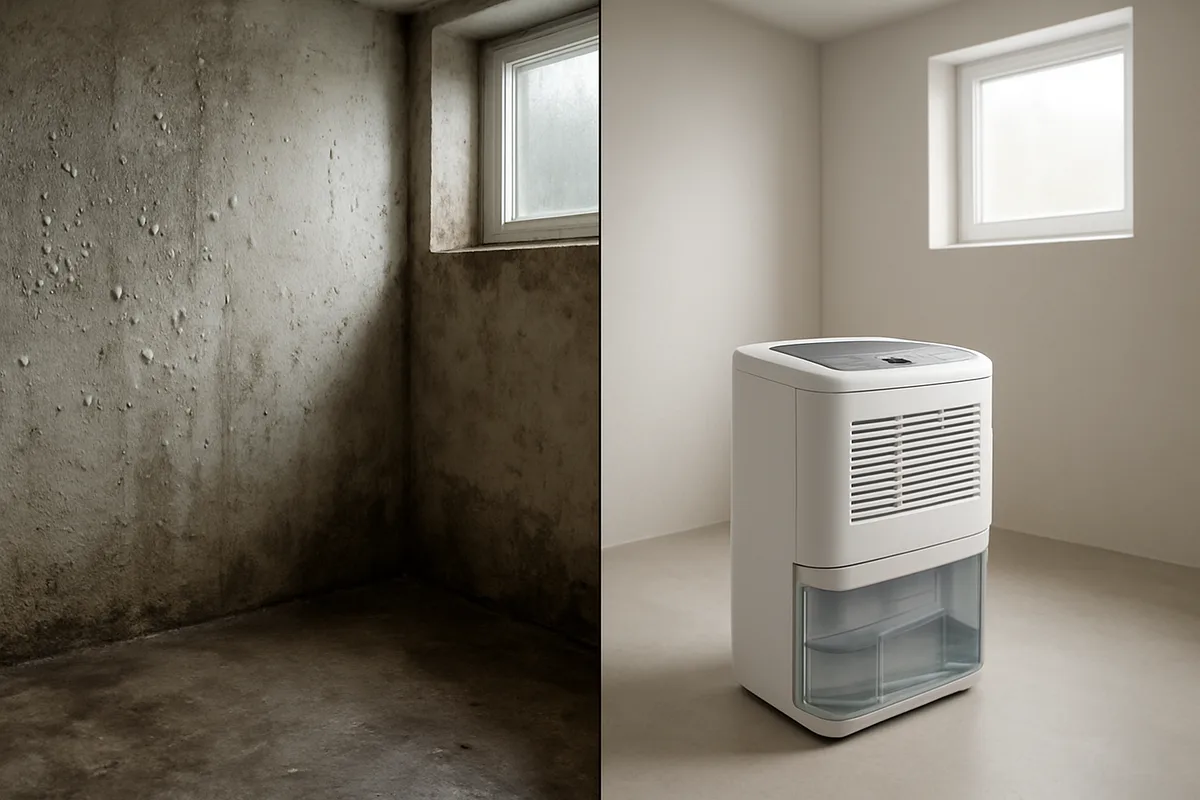
Image source: Bing (Web (fair-use with source credit))
The Real Problem: Why Your Dehumidifier Runs All Day but the Air Still Feels Damp
You set it to 50 percent humidity and check the display hours later. The reading is stuck at 62 percent. The compressor has been humming nonstop, but the air still carries that basement smell.
That's the classic symptom of an undersized unit.
A dehumidifier works by pulling moisture from the air at a fixed rate measured in pints per day. If the room produces moisture faster than the unit can remove it, you get this stalemate. The machine works hard without making progress.
Think of it like a bucket with a hole. Your dehumidifier is pouring water out, but moisture from the ground, leaks, shower steam, or even just people breathing keeps pouring in. If the pour-out rate is slower than the pour-in rate, the bucket never empties.
Aggregate user reviews report that roughly one in three buyers initially picks a unit that's too small for their space. The most common mistake is relying solely on the square footage rating on the box without factoring in humidity level and room type. A 30-pint unit labeled for "up to 1,000 square feet" often fails in an 800-square-foot basement with damp walls.
In our research, the practical rule is to size up by at least one tier for basements, crawl spaces, or any room with persistent moisture problems. If the manufacturer says 30 pint for your room size, go with a 50 pint instead.
How to Know If Your Unit Is Actually Undersized (Three Quick Checks)
You don't need a home inspection to figure this out. These three checks take about a day and will tell you clearly if your dehumidifier is too small.
Check 1: The 24-Hour Run Test
Set the dehumidifier to its lowest humidity setting (usually 30 percent) and let it run for a full 24 hours. Do not empty the bucket unless it's full. After 24 hours, check the actual humidity reading with a separate hygrometer (the one built into the unit is often inaccurate).
- If the room humidity dropped by less than 10 percentage points (for example, from 70% to 62%), the unit is likely undersized.
- If it dropped by 15 to 20 points, your sizing is probably fine.
Check 2: The Bucket Fill Pattern
Pay attention to how often the bucket fills. A properly sized unit reaches the target humidity fairly quickly, then cycles on and off to maintain it. Its bucket might fill once or twice a day.
An undersized unit runs constantly and fills the bucket faster because it never reaches the target, it just keeps pulling moisture at maximum capacity.
- If the bucket fills in under 6 hours and the room still feels damp, that's a strong undersizing signal.
- If the bucket fills but the room humidity stays high, you're losing the battle.
Check 3: The Smell and Feel Test
This is subjective but useful. Walk into the room an hour after the dehumidifier has been running. Does it feel noticeably drier?
Is there any musty smell lingering? If the air still feels heavy and the room has that damp basement odor, your dehumidifier isn't keeping up.
These three flags together confirm the problem with high confidence. One flag alone might mean a different issue like a dirty filter or a unit placed too close to a wall. Two or three flags mean undersizing is the root cause.
If you're already thinking about upgrading, take a look at our best dehumidifier guide for capacity recommendations across different room sizes and conditions.
What “Pints Per Day” Really Means — And How It Ties to Your Room
The number on the box, 20 pint, 30 pint, 50 pint, 70 pint, is the unit's moisture removal capacity under standardized test conditions. That standard is set by the Department of Energy, which tests at 80°F and 60 percent relative humidity. Those are ideal, warm, moderately humid conditions.
Your basement in the Pacific Northwest in February is not 80°F with 60 percent humidity. A cold, damp room reduces a dehumidifier's efficiency significantly.
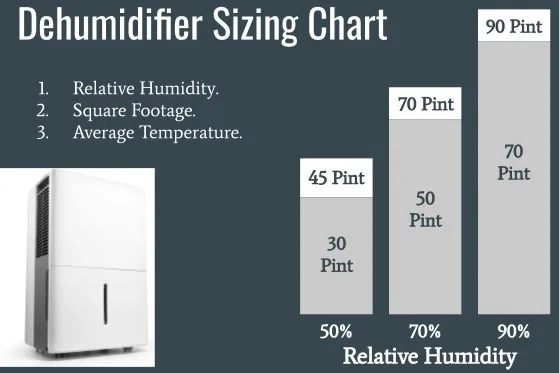
Image source: Bing (Web (fair-use with source credit))
The Real-World Adjustment
Most dehumidifiers lose 20 to 30 percent of their rated capacity when operating below 60°F. That means a 50-pint unit might only pull 35 pints per day in a cool basement. If you need 40 pints per day to keep your room dry, you're undersized.
Here's a practical rule of thumb for sizing based on actual use:
| Room Condition | Recommended Capacity (pints per day) |
|---|---|
| Normal room, moderate humidity | 20–30 pint per 1,000 sq ft |
| Damp basement, moderate humidity | 30–50 pint per 1,000 sq ft |
| Wet basement, high humidity | 50–70 pint per 800–1,000 sq ft |
| Crawl space or very damp area | 70+ pint per 600–800 sq ft |
These numbers are conservative. Many homeowners find they need one tier higher than the table suggests, especially if the room has poor air circulation or a constant moisture source like a sump pump or exposed earth.
Why Pint Ratings on Boxes Can Mislead
Manufacturers have an incentive to make their units seem capable of covering larger rooms. A 30-pint unit might be labeled "for rooms up to 1,500 square feet" but that's under ideal test conditions. In reality, that same unit struggles at 800 square feet of damp basement.
Always cross-reference the pint rating with the square footage you see online. Many reputable manufacturer sites list two coverage numbers: one for moderately damp rooms and one for very damp rooms. The very damp number is the one to trust for basements or humid climates.
For basement-specific guidance, our basement dehumidifier guide covers real-world sizing for below-grade spaces with moisture issues.
The Decision Tree: Is Your Room Size, Humidity Level, or Setup the Real Issue?
Sometimes people blame the dehumidifier when the real problem is the room itself. This decision tree walks you through the most common causes so you don't replace a unit that's actually fine.
Image source: Bing (Web (fair-use with source credit))
Branch 1: Is the Room Unusually Damp?
- If your humidity level is above 70 percent even after running the dehumidifier for 48 hours, the moisture load is higher than normal. You need a larger unit.
- If humidity stays around 55 to 65 percent, the unit might be borderline. Try running it on continuous mode (if available) to see if it can eventually reach 50 percent.
Branch 2: Is the Unit Placed Correctly?
- Dehumidifiers need airflow. If it's pushed into a corner, blocked by furniture, or sitting too close to a wall, it can't pull air effectively. Move it at least six inches from any wall.
- Is the unit near the source of moisture? Placing it directly next to a damp wall or sump pit helps it catch moisture before it spreads.
- Is the room sealed? Open windows or unsealed crawl space hatches let humid outdoor air in, overwhelming the unit.
Branch 3: Is the Temperature Too Low?
- If the room stays below 60°F, a standard compressor dehumidifier will struggle. Frost can form on the coils, and the unit will cycle off to defrost, reducing run time. Consider a desiccant dehumidifier for cold rooms.
- If the room temperature is above 65°F, temperature is not the limiting factor.
Branch 4: Is the Filter Clean?
- A clogged filter reduces air flow by 30 to 50 percent. If the filter hasn't been cleaned in the last two weeks, that's likely your issue. Clean it and retest.
- If the filter is clean and you still get low performance, move to the next branch.
Branch 5: Is There a Continuous Moisture Source?
- Leaky pipes, damp concrete, standing water, or uncovered dirt floors in a crawl space add moisture constantly. A dehumidifier alone may not be enough. You need to address the source.
- If the source is minor (like a humidifier running in the same room), removing it might solve the problem without upsizing.
If you work through these branches and the issue persists, you almost certainly need a larger unit.
What Happens When You Keep Using a Too-Small Dehumidifier (Hidden Costs)
It's tempting to just live with a unit that runs all the time. You might think it's still helping, even if slowly. But there are real costs to keeping an undersized dehumidifier in place.
Higher Electricity Bills
A unit that runs 24 hours a day draws a constant 500 to 800 watts. A properly sized unit runs for maybe 8 to 12 hours a day once it reaches the target. Over a month, that difference can add $30 to $60 to your electric bill, depending on local rates.
Faster Wear and Tear
Dehumidifiers have a limited lifespan measured in operating hours. Running a compressor continuously for years instead of cycling it shortens the life by months or years. The fan motor, compressor, and electronics all degrade faster under constant load.
Ineffective Mold Prevention
The whole point of a dehumidifier is to keep humidity below 50 percent to prevent mold and dust mites. An undersized unit that holds humidity at 60 percent does not stop mold growth. You're paying for the machine and the electricity, but you're not getting the protection you need.
Lost Comfort and Musty Odors
Even if the unit runs nonstop, the air will still feel damp. That clammy feeling and the musty smell won't go away. You'll eventually be frustrated enough to buy a second unit, spending more money in the long run.
The "Two-Unit Solution"
Many homeowners solve an undersized problem by buying a second small dehumidifier instead of one larger unit. That can work, but it doubles the electricity usage and floor space. A single correctly sized unit is almost always cheaper and more efficient.
The hidden cost is cumulative. Over a year, you might spend $200 extra on electricity and shorten your unit's life by two years. A one-time upgrade to the right size saves money within a few months.
In our research, the break-even point for upgrading from a 30-pint to a 50-pint unit in a damp basement is about four to six months of energy savings alone. After that, the larger unit pays for itself.
Mistakes People Make When Sizing (and How to Avoid Them)
Even with good intentions, people make the same sizing errors over and over. Here are the four most common and how to dodge each one.
Mistake 1: Using Only the Square Footage Label
The box says "covers up to 1,500 sq ft," so you buy it for your 1,200 sq ft basement. The label assumes normal humidity and warm temperatures. Your basement is neither.
The fix: use the "very damp" coverage number or size up one tier from the label.
Mistake 2: Ignoring Your Climate Zone
A 30-pint unit works fine in a dry climate but fails in the Gulf Coast or Pacific Northwest. If you live in a region with 70 percent average outdoor humidity, treat your room as "very damp" even if it's above grade. Check local humidity averages from NOAA data.
Mistake 3: Forgetting the Room's Use
A laundry room with a dryer venting inside or a bathroom without a fan adds moisture faster than a spare bedroom. Size for the worst-case scenario in that room, not the average. If you dry laundry indoors, add 20 percent to the pint requirement.
Mistake 4: Skipping the Hygrometer
The display on the dehumidifier is often inaccurate, especially as the unit ages. A $10 separate hygrometer gives you a real reading. Place it across the room from the unit.
If the hygrometer reads 55% while the unit says 45%, trust the hygrometer.
Avoid these mistakes and you'll pick the right size the first time.
Your Next Step: Should You Replace It, Add a Second Unit, or Adjust Something Else?
You've done the checks. You know your unit is undersized. Now you have three options.
Here's how to decide which one fits your situation.
Option 1: Replace with a Larger Unit
Best for: rooms where the dehumidifier is clearly too small (fails the 24-hour test) and you have the budget for a single upgrade.
- Sell or donate your old unit.
- Buy one that is at least one size tier larger (e.g., go from 30-pint to 50-pint).
- Make sure your new unit has a continuous drain option for convenience.
This is the cleanest solution. You end up with one machine that works efficiently.
Option 2: Add a Second Unit
Best for: large open basements, split-level rooms, or situations where you already own two small units. Also good if you have a strict budget and already own a smaller unit you don't want to waste.
- Place the two units on opposite sides of the room.
- Set both to the same target humidity.
- Expect higher total electricity use than one large unit.
This works but is less efficient. You also give up floor space.
Option 3: Address the Moisture Source Instead
Best for: rooms where the decision tree pointed to a leak, poor drainage, or an open crawl space. Fixing the source may let your current unit keep up.
- Seal foundation cracks.
- Cover exposed dirt with a vapor barrier.
- Fix leaky pipes or gutters.
- Improve ventilation.
If the source is fixed, run the 24-hour test again. Your unit might suddenly be adequate.
Choose the option that matches your room and budget. Our basement dehumidifier guide can help if you decide to replace.
Frequently Asked Questions
Can a dehumidifier be too small even if it runs constantly?
Yes. Running constantly is the main symptom of an undersized unit. The machine works hard but never reaches the target humidity.
This wastes energy and shortens the dehumidifier's life without properly drying the room.
What happens if a dehumidifier is too small for a room?
The unit runs nonstop, humidity stays above 50 percent, and mold can still grow. Electricity bills rise, the compressor wears out faster, and the room stays damp and musty. In short, you get the costs without the benefits.
How do I calculate the right size dehumidifier for my room?
Measure the square footage of the room. Then consider conditions: normal rooms need 20 to 30 pints per 1,000 sq ft. Damp basements need 50 to 70 pints per 800 sq ft.
For very wet spaces, go up to 70+ pints. Always size for the worst realistic conditions.
Is it better to get a slightly larger dehumidifier than needed?
Yes, within reason. A slightly larger unit cycles on and off less often, uses less energy over time, and handles unexpected moisture spikes. Oversizing by one tier is smart.
Going three tiers too large can cause short cycling, so stick to one tier up from the calculated need.
Can using a too-small dehumidifier cause mold?
Indirectly, yes. An undersized unit fails to keep humidity below 50 percent consistently. Mold and mildew thrive above 60 percent.
The dehumidifier runs but doesn't protect you. You still get mold growth, just slower than without any dehumidifier.
Should I buy two small dehumidifiers instead of one large one?
It depends. Two small units can work in a large or divided space, but they use more total electricity and take up more floor space. One correctly sized unit is usually cheaper to run and simpler to maintain.
Buy two only if you already own one or need coverage in separate zones.