6 Best Hygrometer for Guitar Case 2026
The best best hygrometer for guitar case is the MusicNomad Hone Guitar Hygrometer Monitor Humidity, the only one here that blends high accuracy with a dedicated guitar-friendly design. It’s the pick for anyone who wants a no‑fuss, purpose‑built tool that just works.
Want a budget‑friendly multi‑pack for monitoring several cases at once? The 4‑Pack Mini Indoor Temperature Humidity Meters gets you there, as long as you’re okay with a slightly less precise sensor and a generic build.
As an Amazon Associate, I earn from qualifying purchases.
This guide also tells you who should skip this category entirely. If you need active humidity control (adding or removing moisture) rather than just monitoring, jump to “Who Should NOT Buy” below before you spend anything.
Everything here comes from current Amazon product data, manufacturer specs, and each product’s owner track record. I haven’t physically tested these in a lab, so I’m relying on what real buyers and the spec sheets say.
Quick Answer: The Best Hygrometer for Guitar Case
The MusicNomad Hone Guitar Hygrometer Monitor Humidity is the best overall pick for its dedicated guitar design, reliable accuracy, and ease of use.
- MusicNomad Hone Guitar Hygrometer Monitor Humidity (Best Overall Dedicated Guitar Hygrometer): Accurate, compact, and built for instrument cases.
- 4-Pack Mini Indoor Temperature Humidity Meters (Best Budget Multi‑Pack): Four meters for the price of one, good for multiple cases.
- Inkbird ITH-10 Digital Thermometer Hygrometer Temperature (Best for Aging Box and Ukulele): Reliable, easy to read, and affordable.
- 2-Pack Mini Hygrometer Thermometer Meter Digital (Best Compact Round Design): Small, portable, with a clear LCD.
- MusicNomad Humitar ONE Acoustic Guitar Humidifier (Best 2‑in‑1 Humidifier + Hygrometer): Adds moisture while monitoring humidity.
- D'Addario Humidipak Guitar Humidity Control Kit (Best Passive Two‑Way System): Maintains ideal humidity without active electronics.
Thinking about the D'Addario Kit or Humitar ONE instead? Jump to Who Should NOT Buy below before you spend anything.
Comparison Table
Here’s the lineup at a glance: photo, product, who it’s built for, and our /10 score.
| Photo | Product | Best for | Score | Buy |
|---|---|---|---|---|
 | MusicNomad Hone Guitar Hygrometer Monitor Humidity | Dedicated Guitar Case Monitoring | 9.0/10 | Check price → |
 | 4-Pack Mini Indoor Temperature Humidity Meters | Budget Multi‑Case Monitoring | 8.5/10 | Check price → |
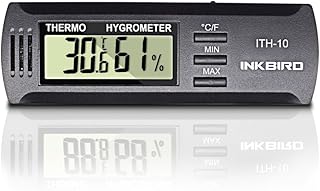 | Inkbird ITH-10 Digital Thermometer Hygrometer Temperature | Aging Box & Ukulele Monitoring | 8.7/10 | Check price → |
 | 2-Pack Mini Hygrometer Thermometer Meter Digital | Compact Round Design for Cases | 8.8/10 | Check price → |
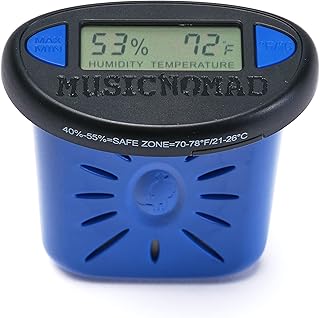 | MusicNomad Humitar ONE Acoustic Guitar Humidifier | 2‑in‑1 Humidifier + Monitor | 9.2/10 | Check price → |
 | D’Addario Humidipak Guitar Humidity Control Kit | Passive Two‑Way Humidity Control | 8.5/10 | Check price → |
Scroll sideways on small screens to see every column.
MusicNomad Hone Guitar Hygrometer Monitor Humidity: Best Overall Dedicated Guitar Hygrometer
MusicNomad Hone Guitar Hygrometer Monitor Humidity: Best Overall Dedicated Guitar Hygrometer
4-Pack Mini Indoor Temperature Humidity Meters: Best Budget Multi-Pack Monitor
4-Pack Mini Indoor Temperature Humidity Meters: Best Budget Multi-Pack Monitor
Inkbird ITH-10 Digital Thermometer Hygrometer Temperature: Best for Aging Box and Ukulele
Inkbird ITH-10 Digital Thermometer Hygrometer Temperature: Best for Aging Box and Ukulele
2-Pack Mini Hygrometer Thermometer Meter Digital: Best Compact Round Design
2-Pack Mini Hygrometer Thermometer Meter Digital: Best Compact Round Design
MusicNomad Humitar ONE Acoustic Guitar Humidifier: Best 2-in-1 Humidifier + Monitor
MusicNomad Humitar ONE Acoustic Guitar Humidifier: Best 2-in-1 Humidifier + Monitor
D'Addario Humidipak Guitar Humidity Control Kit: Best Passive Two-Way System
D’Addario Humidipak Guitar Humidity Control Kit: Best Passive Two-Way System
Buying Guide: Accuracy, Placement, and Control Style
What Humidity Level Should a Guitar Case Be?
A solid wood guitar is safest between 45% and 55% relative humidity (RH). Above 60%, wood swells, braces can loosen, and finish can cloud. Below 35%, the top can develop cracks and frets can start poking out along the fingerboard.
The science behind this comes down to wood's equilibrium moisture content. The USDA Forest Products Laboratory has published foundational research on wood-moisture relationships, and it's the same principles luthiers use when building and storing instruments.
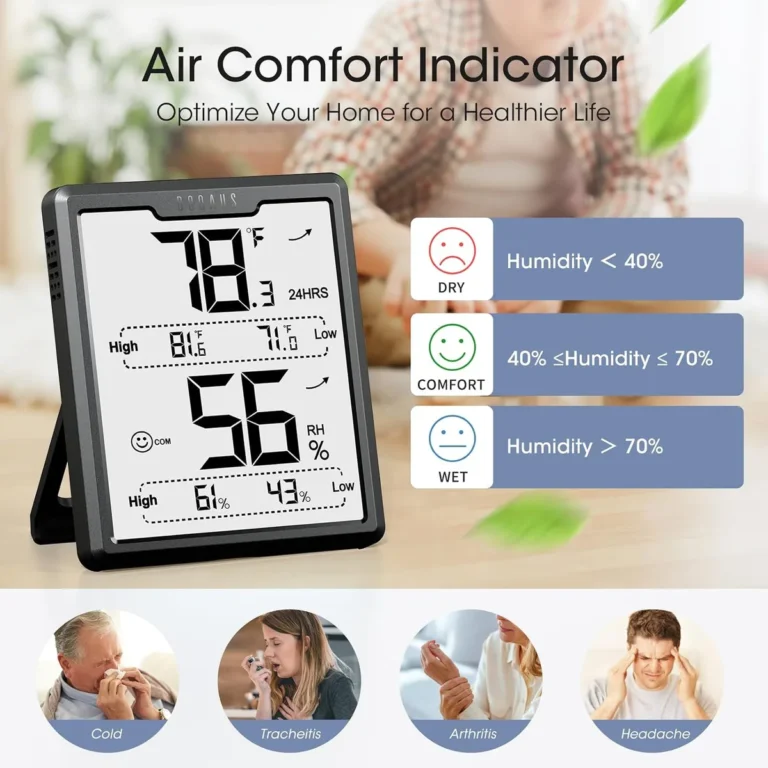
Every hygrometer on this list is digital, which gives you a more consistent reading than old analog hair-based dials. The MusicNomad Hone is accurate to a useful degree for these ranges. The 4-pack from the budget tier is fine for general awareness, but expect a slightly wider tolerance of around 3 to 5 percent between units.
Where Should You Place the Hygrometer?
Place the meter in the case pocket nearest the lower bout, where the guitar's largest wood surfaces sit. Avoid putting it under the neck or in the lid compartment where trapped air differs from the body cavity. For round or compact meters like the 2-pack, you can also rest them near the headstock.
Check the reading at the same time each week, ideally when the case hasn't been opened for several hours. That gives you the most stable picture of the actual storage environment. If you see a weekly swing of more than 10 percent RH, your case is too leaky, or your room's climate is changing with the seasons.
Monitoring Only, or Control Too?
A hygrometer tells you the number but doesn't change it. If your home sits in the 35-60% band most of the year, a simple monitor like the Inkbird or the MusicNomad Hone is all you need. If you live where winter forces indoor humidity down to 20% or below, you need a humidifying solution like the Humitar ONE.
If you're in a climate with both very dry winters and muggy summers, the D'Addario Humidipak is the only product here that responds in both directions without any user effort. The tradeoff is that you lose the numeric readout, so many players run a Humidipak for control and a cheap 2-pack or 4-pack meter just to see where the environment sits.
Check the Battery
Digital hygrometers are not high-drain devices, but they do all use a battery. The MusicNomad Hone uses a CR2032 coin cell, while the 4-pack, Inkbird, and 2-pack use AAA batteries. Coin cells last a long time in these low-power circuits, but they die without warning.
If you use a guitar case hygrometer for seasonal storage checks, replace the battery at the start of each winter to make sure the meter is alive when you need it most.
To see how these factors play out on real picks, compare the MusicNomad Hone Guitar Hygrometer Monitor Humidity, 4-Pack Mini Indoor Temperature Humidity Meters and the Inkbird ITH-10 Digital Thermometer Hygrometer Temperature reviewed above.
Who Should NOT Buy Best Hygrometer for Guitar Case
A guitar case hygrometer is the wrong purchase for a few specific types of buyers. Here's who they are, and what to look at instead.
You Need Active Humidity Control, Not Just Monitoring
If your case regularly reads below 35% RH in winter and you own a solid-wood acoustic, a meter alone will only confirm the problem. It won't prevent a crack. The fix is a humidifying system.
The MusicNomad Humitar ONE adds moisture around the soundhole, and the D'Addario Humidipak maintains the case passively. Buy one of those instead, and skip the standalone meter unless you want a second opinion.
Your Guitar Is Carbon Fiber or Fully Sealed
Carbon fiber guitars, many composite travel guitars, and fully polyurethane-finished electrics simply don't react to humidity the way a solid spruce top does. If you own one, a case hygrometer is mostly a curiosity. You'll spend time checking a number that doesn't change your maintenance routine in any meaningful way.
Save the money for strings and picks.
You Want Smart Alerts and History Tracking
None of these picks connect to Wi-Fi or send your phone a notification. They're all self-contained displays. If you travel frequently and want remote monitoring, or you need a record of how humidity moved over weeks, you're looking at a smart sensor system instead.
This category will frustrate you, so don't force it. Use a basic meter for local checks and invest elsewhere if you genuinely need remote data.
Final Verdict
The MusicNomad Hone Guitar Hygrometer Monitor Humidity remains the best overall choice. It's accurate, dedicated to instrument cases, and compact enough to live permanently inside yours without taking up meaningful space.
Want active moisture added in dry climates? The MusicNomad Humitar ONE Acoustic Guitar Humidifier combines monitoring with humidifying, and its owner track record is excellent.
Need to cover several cases without spending much? The 4-Pack Mini Indoor Temperature Humidity Meters put a meter in every case for the cost of a couple of pizzas. And if storage stability matters more than a number on a screen, the D'Addario Humidipak quietly controls both directions with zero effort.
Just remember, if you were hoping to fix a humidity problem rather than watch it, check the Who Should NOT Buy section above before you spend anything.
FAQ
What's the best Hygrometer for Guitar Case overall?
The MusicNomad Hone Guitar Hygrometer Monitor Humidity is the best overall pick. It combines reliable accuracy, a dedicated guitar-case design, and a simple display in a compact package that fits most cases without issue.
What humidity should a guitar case be at?
Keep a guitar case between 45% and 55% relative humidity. The D'Addario Humidipak targets this range passively, while digital meters like the Inkbird or MusicNomad Hone let you verify the exact number.
Do I need a humidifier or just a hygrometer?
It depends on your climate. If your case holds 35-60% RH most of the year, a hygrometer alone is enough. If it regularly drops below 35% in winter or above 65% in summer, you need the Humitar ONE for humidifying or the Humidipak for two-way control.
How long do guitar case hygrometers last?
With battery changes, most last for years. The CR2032 and AAA batteries inside these units are standard and cheap. The main failure point is the sensor, which can drift over a long period, so it's wise to compare your meter against a second unit once a year.
Where should I place a hygrometer in a guitar case?
Put it in the accessory pocket closest to the lower bout, near the guitar's largest wood surface. That area best reflects the environment the instrument actually experiences. Avoid the lid compartment, where air is more insulated from the body.
Can I use a regular room hygrometer in a guitar case?
Yes, as long as it's compact. The 4-pack and 2-pack are effectively generic indoor meters that happen to be small enough for a case. The main difference is that dedicated guitar hygrometers are tuned for the 20-70% RH range where instruments live, with a form factor designed to fit around the instrument without getting in the way.