How Does a Hygrometer Work
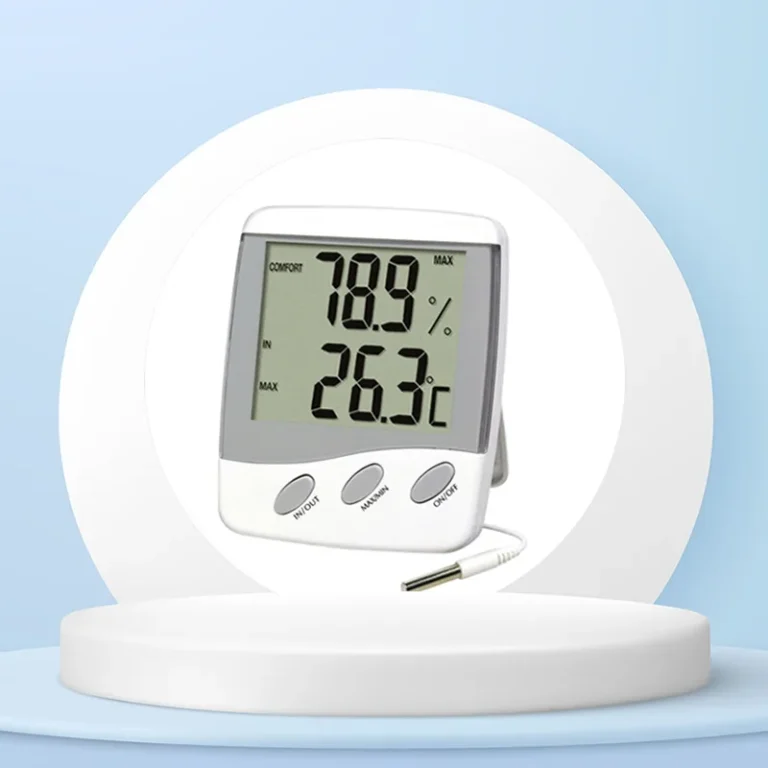
You ever look at a hygrometer, see it reading 45%, and wonder how does a hygrometer work? It's not magic, but it is clever physics. A hygrometer is a tool that measures the amount of water vapor in the air.
And it does it in a few different ways, depending on the type.
The most common reference standard for indoor comfort is ASHRAE Standard 55. It recommends keeping relative humidity between 30% and 60% for human comfort. That's a wide range, but your hygrometer needs to be accurate enough to tell you where you land.
Let's break down the science behind these devices so you can trust what yours is telling you.
Quick Answer
A hygrometer works by measuring the amount of water vapor in the air. Mechanical models use a strand of hair that expands and contracts. Electronic sensors detect changes in capacitance or resistance.
Both methods translate into a relative humidity reading. The result is a percentage that tells you how saturated the air is.
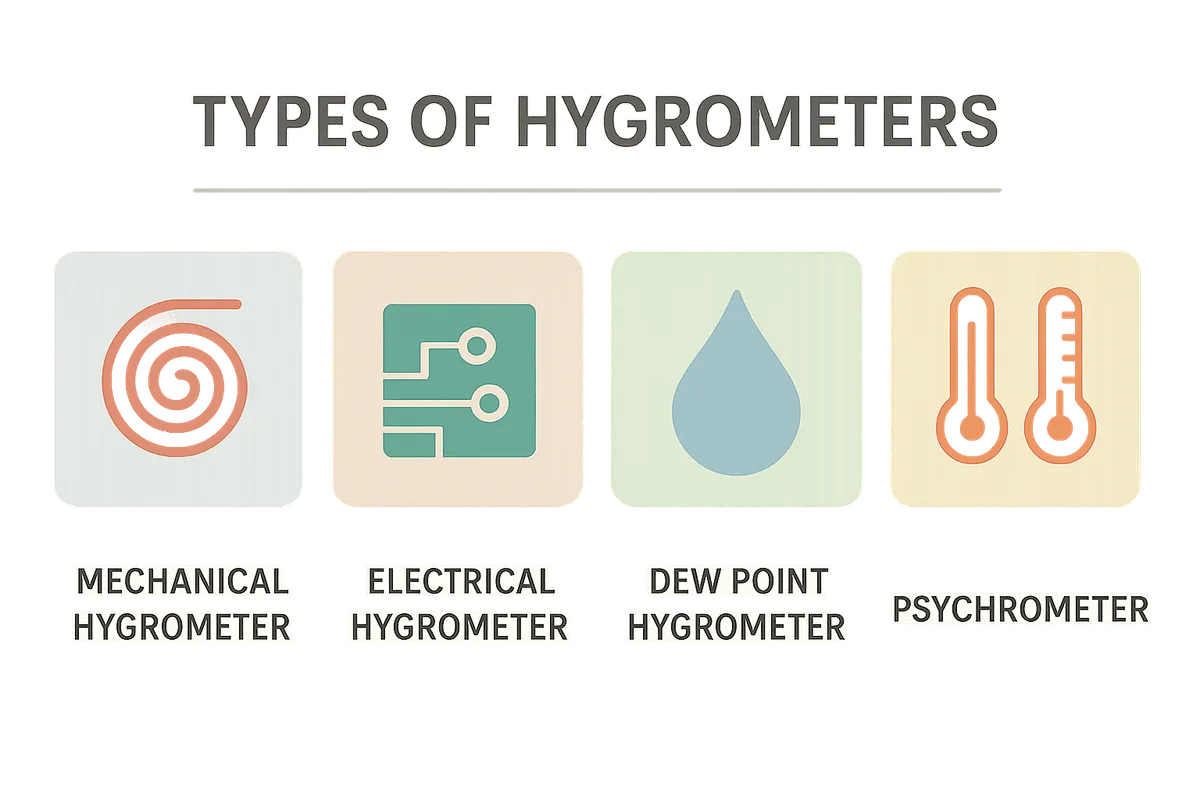
Image source: Bing (Web (fair-use with source credit))
What Does a Hygrometer Actually Measure?
Most people think a hygrometer just tells you if it's humid or dry. That's true, but the number it gives you is a specific scientific measurement. It's called relative humidity, and it's a ratio.
Relative Humidity vs. Absolute Humidity vs. Dew Point
Relative humidity (RH) is the percentage of water vapor in the air compared to the maximum the air can hold at that temperature. Warm air can hold more moisture than cold air. That's why the same amount of water vapor gives you a higher RH on a cool day than on a hot one.
Absolute humidity is the actual mass of water vapor in a given volume of air. It's measured in grams per cubic meter. It ignores temperature entirely.
You'll see it used in industrial drying and meteorology, but rarely in home settings.
Dew point is the temperature at which air becomes fully saturated. When the air cools to its dew point, condensation forms. A high dew point feels muggy.
A low dew point feels crisp.
| Measurement | What It Tells You | Common Unit | Best For |
|---|---|---|---|
| Relative humidity | How saturated the air is | % RH | Home comfort, greenhouses |
| Absolute humidity | Actual water vapor mass | g/m³ | Industrial drying, HVAC |
| Dew point | Temperature where condensation occurs | °F or °C | Weather forecasting, mold prevention |
Why 100% RH Isn't Always Rain
When your hygrometer reads 100% RH, it means the air is fully saturated. But that doesn't automatically mean it's raining. Fog, mist, and heavy dew can all happen at 100% RH without a single raindrop.
The air just can't hold any more water vapor, so any extra condenses out. Your hygrometer is telling you the air is at its limit, not that precipitation is falling.
The Main Types of Hygrometers and How Each One Works
There are five main types of hygrometers you'll encounter. Each one uses a different physical principle to sense moisture. Some are older and mechanical.
Others are modern and electronic. They all serve the same purpose, but they vary in accuracy, cost, and response time.
Mechanical Hair Hygrometer: How a Strand of Hair Detects Moisture
This is the oldest design still in common use. A strand of human hair or synthetic fiber is stretched between a fixed point and a spring. Hair absorbs moisture from the air and expands slightly.
As it lengthens, it moves a needle across a dial.
The key here is that hair is hygroscopic. It naturally pulls in water vapor from the air. The amount of expansion is roughly logarithmic.
The needle moves more at lower humidity levels. These hygrometers are slow. They can take five to ten minutes to stabilize after a change.
They're also prone to drift over time as the hair degrades.
You'll find these in cheap analog weather stations and old-fashioned barometers. They're decent for a rough idea but not for precision work.
Capacitive Hygrometer: The Modern Electronic Sensor
This is the most common type of electronic hygrometer used today. It uses a thin polymer film sandwiched between two electrode plates. The film absorbs water vapor, which changes its dielectric constant.
That change alters the capacitance of the sensor. An electronic circuit measures that capacitance and converts it into a relative humidity reading.
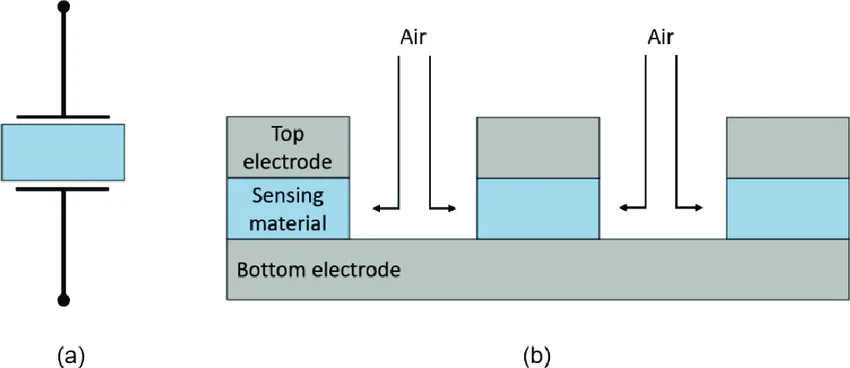
Image source: Bing (Web (fair-use with source credit))
Capacitive sensors are fast, accurate, and stable. They typically respond within 10 to 30 seconds. They're also small enough to fit inside a smartphone or a digital thermostat.
Manufacturer specifications from brands like Sensirion and Honeywell indicate accuracy of plus or minus 2% RH in the 20% to 80% range.
These are the sensors you'll find in most modern digital hygrometers, smart home devices, and weather stations. They're the gold standard for consumer use.
Resistive Hygrometer: The Salt and Ceramic Approach
Resistive hygrometers work on a different principle. They use a material that changes its electrical resistance as it absorbs water. Common materials include lithium chloride, carbon film, and ceramic compounds.
When the material absorbs moisture, its resistance drops. The circuit measures that change and calculates the RH. These sensors are cheaper to produce than capacitive ones.
But they're less accurate and more prone to drift. They also suffer from hysteresis. The reading depends on whether the humidity is rising or falling.
You'll find resistive sensors in very cheap hygrometers and some industrial applications where cost matters more than precision. They're not ideal for critical uses like mushroom cultivation or museum storage.
Psychrometer: The Wet-Bulb and Dry-Bulb Method
A psychrometer is a bit different. It doesn't use a sensor at all. It uses two thermometers.
One is a dry-bulb thermometer that measures air temperature. The other is a wet-bulb thermometer with a wick dipped in water. You spin or fan the pair to evaporate water from the wick.
The wet-bulb temperature drops because evaporation is a cooling process. The drier the air, the more evaporation happens. The lower the wet-bulb reading goes.
You then compare the two temperatures using a psychrometric chart or a formula to find the relative humidity.
This method is very accurate when done correctly. It's the standard for meteorological stations and HVAC testing. But it's manual.
You have to wet the wick, spin it, and read the thermometers. It's not a set-it-and-forget-it device.
Chilled Mirror Hygrometer: The Industrial Gold Standard
This is the most accurate hygrometer type available. It uses a mirror that is cooled until condensation forms on its surface. A light beam reflects off the mirror.
A sensor detects when the beam scatters due to condensation. The temperature at that exact moment is the dew point.
From the dew point and the ambient temperature, the device calculates the relative humidity. Chilled mirror hygrometers are accurate to within 0.1 degrees Celsius of dew point. They're expensive.
They often cost hundreds or thousands of dollars. You'll find them in calibration labs, pharmaceutical manufacturing, and high-precision industrial settings.
What's Inside a Hygrometer: A Visual Tour of the Components
If you could open up a hygrometer and look inside, you'd see different components depending on the type. Let's walk through the key parts.
Reading the Analog Dial: Gears, Springs, and Hair
Inside an analog hygrometer, you'll find a hair bundle or synthetic fiber stretched between a fixed anchor and a lever arm. The lever arm connects to a gear train that multiplies the tiny movement of the hair. That gear train spins the needle on the dial.
The hair bundle is usually held under tension by a small spring. Without the spring, the hair would sag and the needle would stick. The gear train is delicate.
A single drop of water or a dust particle can jam it. That's why cheap analog hygrometers often fail after a few months.
Looking Inside a Digital Sensor: Capacitor Plates and Polymer Films
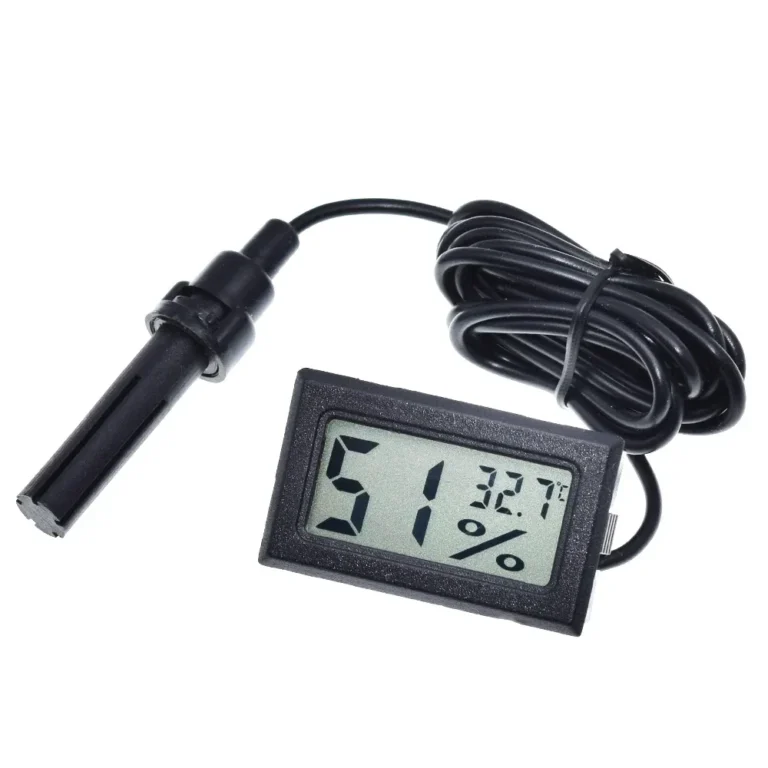
A digital capacitive hygrometer contains a small printed circuit board with a sensor chip. The sensor chip has a thin polymer film between two conductive plates. The film is exposed to the air through a small vent or mesh.
The chip measures the capacitance and sends the data to a microcontroller.
The microcontroller converts the raw capacitance value into a humidity percentage using a calibration curve stored in its memory. It also compensates for temperature because capacitance changes with temperature. The result is displayed on an LCD screen or sent over Wi-Fi.
The Psychrometer's Wick and Ventilation System
A psychrometer has two thermometers, a water reservoir, and a wick. The wick is usually a cotton sleeve that fits over the wet-bulb thermometer bulb. The reservoir keeps the wick moist.
The ventilation system, either a fan or a hand sling, ensures consistent airflow across both bulbs.
The entire setup relies on the user maintaining the wick's cleanliness and moisture. A dirty wick or insufficient water gives inaccurate readings. Professional psychrometers use distilled water to avoid mineral buildup on the wick.
How to Read and Place Your Hygrometer Correctly
Even the best hygrometer gives bad data if you place it wrong. The sensor needs to sample the air in the room. Not the air near a wall, window, or heating vent.
Where to Put It: The Right Spot for Accurate Readings
Place your hygrometer in a central location. Keep it about four to five feet off the floor. Keep it away from direct sunlight, radiators, air conditioning vents, and exterior walls.
A shelf in the middle of a room is ideal. Avoid bathrooms, kitchens, and basements unless you specifically want to monitor those spaces.
If you're measuring humidity for a specific purpose, like a cigar humidor or a guitar case, place the sensor inside that space. The general rule is that the sensor should be in the same air volume as the thing you're trying to protect.
How Long to Wait Before Trusting the Reading
Hygrometers don't respond instantly. Electronic sensors need about 10 to 30 seconds to stabilize. Mechanical hair hygrometers can take up to 10 minutes.
If you move the device from one room to another, wait at least 15 minutes before reading it.
For a psychrometer, you need to spin or fan it for 30 to 60 seconds. Then read the wet-bulb temperature immediately. The reading changes as the wick dries out.
Understanding the Comfort Zone: 30%, 50%, 70% and What Each Feels Like
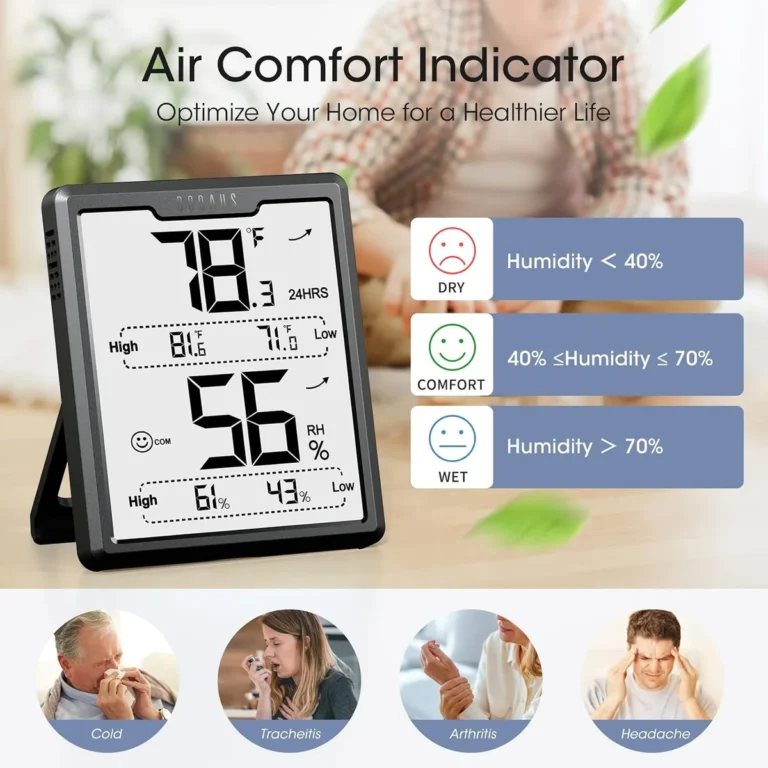
The human comfort zone falls between 30% and 60% RH. Here's what each range feels like:
| Humidity Level | How It Feels | Risks |
|---|---|---|
| Below 30% | Dry air, static shock, chapped lips | Wood cracking, respiratory irritation |
| 30% to 50% | Comfortable, fresh | Ideal for most homes |
| 50% to 60% | Slightly humid, still comfortable | Mold risk increases above 55% |
| 60% to 70% | Sticky, clammy | Mold growth, dust mite activity |
| Above 70% | Muggy, oppressive | Condensation, rot, structural damage |
If your hygrometer reads consistently above 60%, you need a dehumidifier. Below 30%, a humidifier helps. The sweet spot is right around 45%.
Common Hygrometer Mistakes and Visual Errors to Avoid
You'd be surprised how many people get a hygrometer, stick it on a windowsill, and wonder why it reads 80% on a sunny day. Here are the most common mistakes.
Placing It Near Windows, Vents, or Sunlight
Windows are cold surfaces in winter and hot surfaces in summer. The air near a window is not representative of the room. Air vents blow dry or humid air directly onto the sensor.
Sunlight heats the sensor, causing it to read lower than actual humidity. Avoid all three.
Touching the Sensor or Letting Condensation Settle In
The sensor on a digital hygrometer is a small exposed component. Touching it transfers oils from your skin. This can affect accuracy.
Condensation forms on the sensor if the humidity is very high. This causes it to read 100% until the water evaporates. If you see condensation, wipe the sensor gently with a lint-free cloth and wait 30 minutes.
When the Analog Needle Sticks: Stiction and How to Spot It
Analog hygrometers suffer from stiction. The needle sticks in place. You can test for this by gently tapping the glass.
If the needle moves and then settles back, you have stiction. The fix is usually a gentle tap or a calibration check. If it sticks frequently, the gear train may be dirty or damaged.
Ignoring Calibration Drift
Every hygrometer drifts over time. Capacitive sensors drift about 1% to 2% per year. Hair hygrometers drift faster.
If you've had your hygrometer for more than a year without calibrating it, you're probably reading a number that's off by several percentage points. The salt test is a simple way to check. We'll cover that in the next section.
Hygrometer Specs Compared: Accuracy, Response Time, and Cost
Not all hygrometers are created equal. The type you choose depends on what you need. A cigar humidor needs different accuracy than a weather station.
Here is a side by side comparison of the five main types.
| Type | Accuracy | Response Time | Cost Range | Best For |
|---|---|---|---|---|
| Mechanical hair | ±5% to ±10% RH | 5 to 10 minutes | $5 to $30 | Decorative, rough indication |
| Capacitive | ±2% to ±3% RH | 10 to 30 seconds | $10 to $100 | Home, greenhouse, smart devices |
| Resistive | ±3% to ±5% RH | 30 to 60 seconds | $5 to $20 | Budget digital hygrometers |
| Psychrometer | ±1% to ±2% RH | 30 to 60 seconds (manual) | $20 to $150 | HVAC testing, meteorology |
| Chilled mirror | ±0.5% RH or better | 1 to 5 seconds | $500 to $5,000+ | Labs, industrial, calibration |
How to Calibrate Your Hygrometer at Home (The Salt Test)
You can check your hygrometer's accuracy with a simple salt test. The National Institute of Standards and Technology (NIST) recognizes this method for basic verification.
Take a small jar or bag. Add a tablespoon of table salt. Add a few drops of distilled water until the salt is wet but not dissolved.
Place your hygrometer inside the sealed container with the salt. Wait 8 to 12 hours. The air above the salt slurry stabilizes at exactly 75% RH at room temperature.
Check the reading. If it shows 75%, your hygrometer is accurate. If it reads 70%, you know it reads 5% low.
You can mentally adjust or use a calibration offset if your device supports it.
How Often to Recalibrate
Capacitive sensors drift about 1% to 2% per year. Check them every 12 months. Hair hygrometers drift faster.
Check them every 6 months. Psychrometers need no calibration, but the wick must be clean and the water must be distilled.
If you use your hygrometer for critical applications like mushroom cultivation or museum storage, recalibrate every 6 months. For home comfort, annual checks are enough.
Frequently Asked Questions
Why Does My Hygrometer Read 99% Even When It's Not Raining?
A reading of 99% RH means the air is nearly saturated. This can happen in fog, heavy dew, or after a shower. It can also happen if the sensor is wet or near a humidifier.
Check the placement first. If the sensor is dry and the reading persists, calibrate it.
Can I Use a Hygrometer in My Fridge or Cigar Humidor?
Yes, but choose the right type. Capacitive hygrometers work well in refrigerators and humidors. They handle the lower temperature range.
Mechanical hair hygrometers are common in cigar humidors. They are accurate enough for the 65% to 75% range that cigars need.
What's the Difference Between a Hygrometer and a Hydrometer?
A hygrometer measures humidity in the air. A hydrometer measures the density of a liquid. They sound similar but are completely different tools.
Do not confuse them. A hydrometer is used for brewing, battery testing, and measuring specific gravity.
Do Smartphone Humidity Apps Work?
Most smartphone apps use the phone's built-in sensors. Many phones do not have a humidity sensor. Those that do are often inaccurate.
Our research shows that phone sensors typically drift by 5% to 10% RH. A dedicated hygrometer is far more reliable.