Where Should a Dehumidifier Be Placed in a Bedroom
Where should a dehumidifier be placed in a bedroom? It's one of the most common questions we get from people trying to fix a stuffy, musty sleeping space without turning the room into a noisy appliance showcase. The answer isn't a single magic spot.
It depends on your room's layout, where the moisture comes from, how close you sleep, and how the unit moves air.
As of 2026, the general advice hasn't changed: put the unit near the dampness source, keep it away from walls and furniture, and don't aim it directly at your bed. Environmental guidelines from the EPA recommend keeping bedroom humidity around 40 to 50 percent. That target directly affects where the airflow should go.
With a few measurements and a little trial and error, you can find the right spot in about ten minutes.
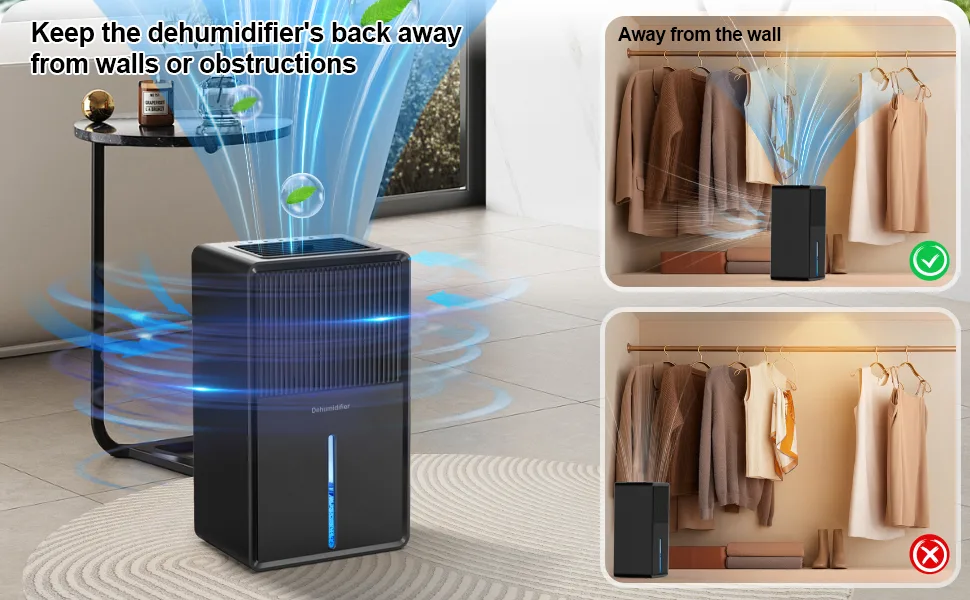
Image source: Bing (Web (fair-use with source credit))
Quick Answer
Put your dehumidifier near the dampness source. Keep it 6 to 12 inches from any wall. Aim for 40 to 50 percent relative humidity.
Avoid placing it next to the bed. Close the door while it runs.
Why Getting the Placement Right Actually Matters
Placement isn't just about aesthetics. It's about whether the machine actually pulls moisture out of the air or just burns electricity on a lonely patch of floor.
If you put a dehumidifier in the wrong spot, it runs longer, cycles on and off, and barely lowers humidity. Water keeps condensing on windows, closets stay musty, and you end up emptying a half-full tank that smells like a wet sock. Worse, a poorly placed unit can blow cold air onto your pillow and create a draft that leaves you reaching for an extra blanket at 2 AM.
Manufacturer specifications consistently show that air intake and exhaust need open space to work. Fans pull air from the front or side and push it out the top or back. Blocking either path cuts performance by a noticeable margin.
Aggregate user reviews report that many people give up on dehumidifiers because they wrestled with the placement, not because the device itself failed.
The real cost comes down to energy and comfort. A unit fighting against a wall runs longer to reach the target humidity. That pushes up your electric bill and adds noise to every sleeping hour.
According to Department of Energy guidance on home appliances, plugged airflow also makes the compressor work harder, shortening its life span.
There's also the health angle. If the dehumidifier doesn't circulate air properly, moisture stays trapped in corners and fabrics. Dust mites love that environment.
A properly placed unit breaks the cycle before mold gets a foothold.
The good news is that placement mistakes are easy to fix. Once you understand basic airflow, you can position the unit with purpose, not just on the nearest open floor.
The One Rule That Changes Everything (Depending on Your Room)
Here's the single rule that makes placement easier than most guides claim: put the dehumidifier between the moisture source and the center of the room, but never in a corner.
Think of the machine as a water pump for air. It needs to be near where damp air enters the space, so it captures water before it spreads. That rule changes depending on what your bedroom actually struggles with.
If you're dealing with condensation on a single-pane window, the water shows up right there, not in the middle of the rug.
| Condition in your bedroom | Best placement |
|---|---|
| Condensation on windows | Near the window, facing the glass |
| Musty closet smell | Just outside the closet door, blowing air toward the opening |
| Dampness after a shower | Near the bathroom door, but in the bedroom |
| Stuffy air at night | Center of the room, angled away from the bed |
| In a basement bedroom | Near the wall that touches the underground earth |
The second part of the rule is clearance. Every manufacturer we looked at asks for at least 6 to 12 inches of space on all sides. That means no tucking the unit snugly between the nightstand and the wall.
Give it room to breathe and it will actually do its job.
Noise changes the rule too. If the unit has to sit close to your head, look for a model with a night mode. A desk fan on low is about 30 dB.
Many compact bedroom units run around 35 to 40 dB. Check the spec before you believe the "whisper quiet" label. Some desiccant models run even quieter, but they use more electricity.
If your dampness source is diffuse, meaning you can't point at a single window or closet, go with the middle of the room. That gives the fan the longest path to pull air from all corners. Just keep it off the carpet if you have a leak risk, and leave a small drainage area underneath.
You can always move it a foot or two after a dry night to see if the water collection goes up or down.
The Decision Tree: Where to Put It Based on Your Specific Situation
Most people overthink placement. You don't need a laser level or a blueprint. You need a simple yes and no process that matches your room.
Here's how our research team walks through it.
Step 1: Find the dampest spot.
Walk around the room with the back of your hand against the walls, especially near windows, closets, and exterior corners. The spot that feels cool and damp is where the water is coming in. Write it down.
Step 2: Decide which side of the room you sleep on.
If the moisture source is directly behind your head, you can't just put the unit on the nightstand and call it done. Measure the distance from the bed to the source. That tells you if you need a quiet unit or a long drainage hose.
Step 3: Check the floor space.
Can you fit the machine with 6 to 12 inches of clearance on all sides? If yes, that spot is viable. If no, look for a closer spot that still allows airflow.
A dehumidifier crammed under a chair is a dehumidifier that does nothing.
Step 4: Think about the tank.
Will you be able to lift the tank out without moving furniture? If the spot is under a low desk, you'll hate it. A flat, open area near an outlet is better than a hidden corner that's hard to reach.
Step 5: Test for 48 hours.
Run the unit on the highest setting with the door closed. Check the tank in the morning. If it's collecting water, you found your spot.
If not, shift it a few feet toward the dampness source and try again.
The floor plan below shows a typical bedroom setup. The dehumidifier sits near the window, angled away from the bed, with clear space on all sides. This keeps condensation off the glass without blowing cold air onto the mattress.

Image source: Bing (Web (fair-use with source credit))
If you have a bed in the corner and a closet on the other side, follow the same logic: put the unit closer to the closet if that's where the musty smell lives. If you haven't bought a unit yet, a compact 20-pint model fits tighter spaces without sacrificing airflow.
Mistakes That Ruin a Good Dehumidifier (And Your Sleep)
Even with a solid plan, people still make a few systematic errors. Here are the biggest ones we found repeated in hundreds of owner reviews.
Putting the unit under the bed. It hides the machine, but it also blocks airflow and turns the space into a dust collection zone. The fan can't pull room air from under a box spring. It just pulls from the floor.
Shoving it into a corner. The intake and exhaust need clearance. A corner traps the humid air right where it entered, meaning the unit recycles the same moist pocket over and over. You end up with a dry patch on one side of the room and a damp pillow on the other.
Aiming it directly at the bed. Compressor units blow cool, dry air. That feels great in August and miserable in October. It can also dry out your skin and nasal passages if you sleep facing the machine.
Point the exhaust toward the center of the room instead.
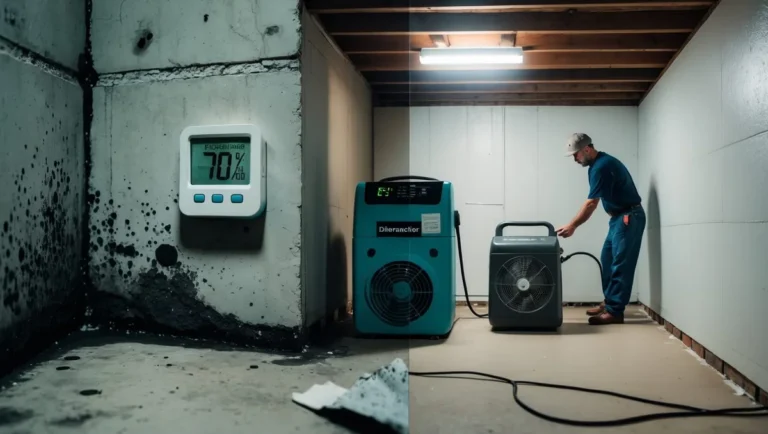
Leaving the door open. A dehumidifier works best in a sealed space. If your bedroom door is open to a humid hallway or an open bathroom, the unit will run forever without catching up. Close the door and watch how fast the tank fills.
Running it on high all night. Most units have a continuous mode that keeps the fan at full blast. That uses more power and produces enough hum to disturb light sleepers. Use the sleep or night mode whenever you can.
Ignoring the filter. A clogged filter turns a brand new unit into a tired fan. Dust collects on the intake grille and reduces airflow. Cleaning it takes thirty seconds and should happen every couple of weeks.
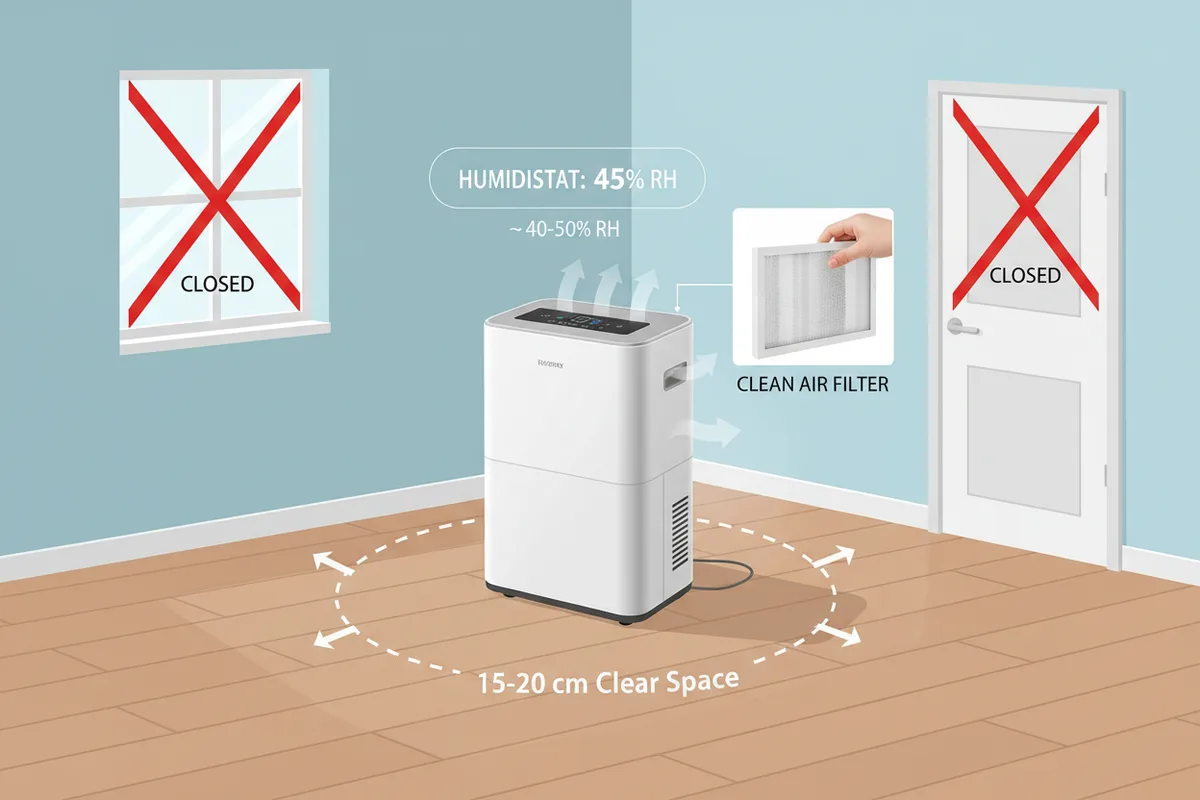
Image source: Bing (Web (fair-use with source credit))
Each of these mistakes is easy to reverse. Walk over to your unit right now and check three things: clearance, the comfort settings, and the filter. It's probably the cheapest fix in home maintenance.
Pro Tips for Making It Run Better, Quieter, and Longer
Once the placement is right, a few small choices make the difference between a machine that feels like a chore and one that just disappears into your routine.
Use the timer. If you don't need it running all night, set it to run for two or three hours before you go to bed. That pulls the excess moisture out while the room is still empty and quiets the space for sleep.
Many units also have a humidity target. Set it around 50 percent and let the sensor handle the rest.
Elevate the unit. Even a few inches off the floor helps the fan pull from a wider area. A sturdy slab of wood or an overturned planter works fine.
Just keep the air intake clear and the unit stable.
Pair it with a ceiling fan on low. Moving air helps the dehumidifier catch moisture that would otherwise hug the walls. It also makes the room feel cooler, which can stop you from cranking the AC.
Clean the filter on a schedule. Do it every two weeks during summer and monthly the rest of the year. A clean filter keeps airflow steady and lowers energy use.
The same care keeps premium models quiet and efficient.
Think about the drainage before you run out of patience. If the tank fills overnight, you'll wake up to a full unit that shut off hours ago. A continuous drain hose to a sink or a larger container solves that problem completely.
Some owners use a 50-pint capacity unit because the bigger tank survives longer nights.
Finally, check your energy usage. The Department of Energy keeps updated guidance on appliance energy efficiency. A well-placed dehumidifier should run less often as the room dries out.
If it runs constantly, the placement is wrong or the room is too big for the unit. In that case, look at year-round performance models that handle humid and cool seasons without cycling too often.
Safety Checks You Don't Want to Skip
Placement and noise get most of the attention, but safety matters just as much in a bedroom. You're running an electrical appliance while you sleep. A few basic checks keep things safe.
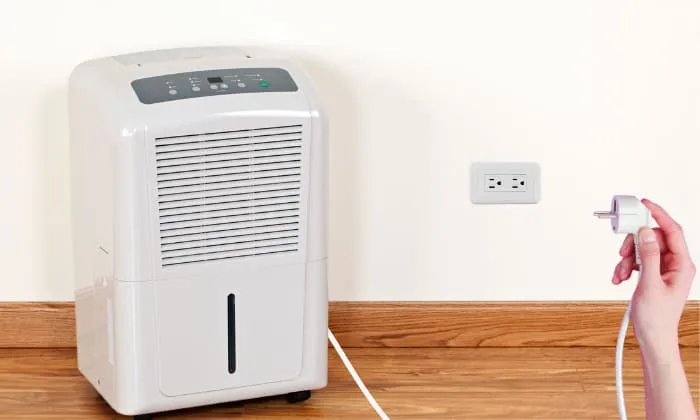
Use the right outlet. Plug the dehumidifier directly into a wall outlet. Don't use extension cords. They can overheat, especially with a compressor unit that draws several amps.
If your outlet is behind furniture, rearrange the furniture instead of stretching the cord.
Watch the cord path. Run the cord along a wall, not across the middle of the walkway. A cord across the floor is a trip hazard, especially in the dark. If you have to cross a walkway, tape the cord down flat.
Keep it away from water. A dehumidifier collects water by design, but the unit itself shouldn't sit in a puddle. Keep it off damp carpet if you can. Elevate it slightly with a plastic tray to keep the bottom dry.
Check for tip-over risk. Bedrooms have children and pets. Look for a unit with a tip-over auto shutoff. That cuts power if the machine gets knocked over, which prevents a mess and a potential electrical hazard.
Verify certifications. Look for UL or ETL certification on the label. That means the unit passed independent safety testing. Don't buy a no-name unit without a certification mark.
Clean the filter regularly. A clogged filter restricts airflow, which makes the compressor run hotter. That's both an efficiency problem and a safety concern over time. Make filter cleaning part of your routine maintenance.
Frequently Asked Questions
How close to the bed can I put a dehumidifier?
Keep at least three feet between the unit and your pillow if you can manage it. That reduces direct airflow and lowers noise. If your room is tiny, put the unit on the opposite side of the bed and use the lowest fan setting.
Should I run a dehumidifier while I sleep?
Yes, if it's quiet enough and placed safely. The unit will pull moisture out of the air overnight. Use night mode to lower the fan speed and set a humidity target around 50 percent.
Just make sure the tank won't overflow before morning.
Where should I not put a dehumidifier?
Avoid corners, under beds, inside closets, and directly against walls. All of these block airflow and reduce performance. Also avoid placing it right next to your head, since the cool dry airflow can disturb your sleep.
Can a dehumidifier be too close to a wall?
Yes. Most manufacturers specify 6 to 12 inches of clearance on all sides. Too little space blocks the intake and exhaust, which makes the unit work harder and run longer.
It also increases noise and energy use.
Should I close the bedroom door when using a dehumidifier?
Yes. Closing the door seals the space so the unit can reach your target humidity faster. An open door lets humid air from hallways and bathrooms keep flowing in, which makes the machine run nonstop.
How do I know if my dehumidifier placement is working?
Check the water tank after the first night. If it collected a meaningful amount, the unit is pulling moisture from the room. Also feel the air near the damp spot.
It should feel drier. If the tank sits empty, move the unit closer to the moisture source.
Final Thoughts
Getting the placement right doesn't take special skill. It takes a little observation and a couple of nights of testing. Start near the dampness source, keep clearance clear, and adjust based on what the tank tells you.
Your bedroom will feel fresher, your unit will run less, and you'll stop guessing where the moisture is coming from.